Week 21
Week 21: Thursday, April 2, 2026
Christopher Columbus
Week 21
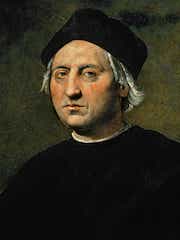
Christopher Columbus (October 1451 – 20 May 1506) His name in Italian: Cristoforo Colombo. In Catalan: Cristòfor Colom. In Spanish: Cristóbal Colón. In Portuguese: Cristóvão Colombo. In Latin: Christophorus Columbus. In Genoese: Christoffa Corombo
Christopher Columbus was a scholar, explorer, and navigator, born in the Republic of Genoa, in northwestern Italy. Under the auspices of Queen Isabella and King Ferdinand, he completed four voyages across the Atlantic Ocean that led to general European awareness of the American continents in the Western Hemisphere. Those voyages, and his efforts to establish permanent settlements in the island of Hispaniola, initiated the process of Spanish colonization, which foreshadowed the general European colonization of the New World.
In the context of emerging western imperialism and economic competition between European kingdoms seeking wealth through the establishment of trade routes and colonies, Columbus' proposal to reach the East Indies by sailing westward received the support of the Spanish crown, which saw in it a promise, however remote, of gaining the upper hand over rival powers in the contest for the lucrative spice trade with Asia.
During his first voyage in 1492, instead of reaching the Indies as he had intended, Columbus landed in the Bahamas archipelago, at a locale he named San Salvador. Over the course of three more voyages, Columbus visited the Greater and Lesser Antilles, as well as the Caribbean coast of Colombia, Venezuela and Central America, claiming them for the Spanish Empire.
Columbus' voyages led to the first lasting European contact with America, inaugurating a period of European exploration and colonization of foreign lands that lasted for several centuries. They had, therefore, an enormous impact in the historical development of the modern Western world. Columbus himself saw his accomplishments primarily in the light of the spreading of the Christian religion. Never admitting that he had reached a continent previously unknown to Europeans, rather than the Indies he had set out for, Columbus called the inhabitants of the lands he visited indios (Spanish for "Indians").
Columbus' strained relationship with the Spanish crown and its appointed colonial administrators in America led to his arrest and dismissal as governor of the settlements in Hispaniola in 1500, and later to protracted litigation over the benefits which Columbus and his heirs claimed were owed to them by the crown.
REQUIRED READING:
Read the "Introduction" and the First Voyage
The Four Voyages: Being His Own Log-Book, Letters and Dispatches with Connecting Narratives,
Penguin Classic,
ISBN 0140442170
RECOMMENDED READING:
Here is a new biography of Columbus, the first new one in English in sixty years, and you will enjoy it and learn a lot. It is also available in new quality paperback from Penguin.
Laurence Bergreen's ambitious new biography, Columbus: The Four Voyages [is] a spellbinding epic that's simultaneiously a profoundly private portrait of the most complex, compelling, controversial creature ever to board a boat. This scrupulously researched, unbiased account of four death-defying journeys to The New World reveals the Admiral's paradoxical personality."
— USA Today
22
Week 22: Thursday, April 9, 2026
Martin Luther
Week 22
Martin Luther (1483-1546) was a German priest, theologian, author, hymnwriter, professor, and former Augustinian friar. Luther was the seminal figure of the Protestant Reformation, and his theological beliefs form the basis of Lutheranism. He is widely regarded as one of the most influential figures in Western and Christian history.
Born in Eisleben, Luther was ordained to the priesthood in 1507. He came to reject several teachings and practices of the contemporary Roman Catholic Church, in particular the view on indulgences and papal authority. Luther initiated an international debate on these in e.g. his Ninety-five Theses, which he authored in 1517. In 1520, Pope Leo X demanded that Luther renounce all of his writings, and when Luther refused to do so, excommunicated him in January 1521. Later that year, Holy Roman Emperor Charles V condemned Luther as an outlaw at the Diet of Worms. When Luther died in 1546, his excommunication by Leo X was still in effect.
Luther taught that justification is not earned by any human acts or intents or merit; rather, it is received only as the free gift of God's grace through the believer's faith in Jesus Christ. He held that good works were a necessary fruit of living faith, part of the process of sanctification. Luther's theology challenged the authority and office of the pope and bishops by teaching that the Bible is the only source of divinely revealed knowledge on the Gospel, and opposed sacerdotalism by considering all baptized Christians to be a holy priesthood. Those who identify with these, as well as Luther's wider teachings, are called Lutherans, although Luther insisted on Christian or Evangelical (German: evangelisch), as the only acceptable names for individuals who professed Christ.
Luther's translation of the Bible from Latin into German made the Bible vastly more accessible to the laity, which had a tremendous impact on both the church and German culture. It fostered the development of a standard version of the German language, added several principles to the art of translation, and influenced the writing of an English translation, the Tyndale Bible. His hymns influenced the development of singing in Protestant churches. His marriage to Katharina von Bora, a former nun, set a model for the practice of clerical marriage, allowing Protestant clergy to marry.
(Wikipedia)
MATERIAL ON THE WEB
Chronology of the 15th century
Chronology of the 16th century
Biography of Martin Luther
REQUIRED READING
The Ninety-Five Theses
RECOMMENDED READING
The biography of Luther that everyone should own is the one book on Luther that has dominated all studies of Luther in the United States for the last fifty years. It is the work of Roland Bainton, the Titus Street Professor of Ecclesiastical History at Yale for almost half a century. Bainton was the professor of my professor, Lewis Spitz. So I am his academic "grandson." Bainton's biography of Luther is still in print fifty five years after its first publication. It's a complete bargain in hardcover, at $14.
RECOMMENDED READING: NEW BOOK ON LUTHER
Martin Luther: The Man Who Rediscovered God and Changed the World,
Viking; First Edition edition (October 3, 2017),
ISBN 110198001X
23
Week 23: Thursday, April 16, 2026
Rembrandt
Week 23

Rembrandt Harmenszoon van Rijn (1606 – 1669), was a Dutch Golden Age painter, printmaker, and draughtsman. He is generally considered one of the greatest visual artists in the history of Western art. It is estimated that Rembrandt's surviving works amount to about three hundred paintings, three hundred etchings and several hundred drawings.
Unlike most Dutch painters of the 17th century, Rembrandt's works depict a wide range of styles and subject matter, from portraits and self-portraits to landscapes, genre scenes, allegorical and historical scenes, biblical and mythological subjects and animal studies. His contributions to art came in a period that historians call the Dutch Golden Age.
Rembrandt never went abroad but was considerably influenced by the work of the Italian Old Masters and Dutch and Flemish artists who had studied in Italy. After he achieved youthful success as a portrait painter, Rembrandt's later years were marked by personal tragedy and financial hardships. Yet his etchings and paintings were popular throughout his lifetime, his reputation as an artist remained high, and for twenty years he taught many important Dutch painters. Rembrandt's portraits of his contemporaries, self-portraits and illustrations of scenes from the Bible are regarded as his greatest creative triumphs. His approximately 40 self-portraits form an intimate autobiography.
MATERIAL ON THE WEB
Chronology of the 17th century
Rembrandt page
Rembrandt biography
REQUIRED READING
No required reading
24
Week 24: Thursday, April 23, 2026
Birth of Modern Science
Week 24
We can cite many steps in the history of Western Civilization that led to today's modern science. The Greeks, of course, began simple experimental science. We can think of Euclid, and of Ptolemy and the experiments he carried out in the Egyptian desert to calculate the size of the earth. Later, Islamic centers pursued experimental science, especially mathematical. Medieval philosophers such as Roger Bacon understood empirical science.
In the early 1400's, a scientific center at the Florentine Cathedral experimented and achieved some sophisticated research under the leadership of many Florentine philosophers, as well as Brunelleschi and other artists.
Lacking in all of these earlier phases of science were three essential aspects of modern science: 1) devices such as the microscope, developed specifically to be used in discovery and experimentation; 2) A publicly chartered institution, with its own building, established for and dedicated to science; and 3) a scientific publication. These three new features of modern science appeared in England in the 1660s, during the monarchy of Charles II.
RECOMMENDED READING
This book based on lectures delivered earlier, was first published in 1957. There have been many other books since then on this subject, but Butterfield is still the right place to begin. A great book and still in print.
The Origins of Modern Science,
Free Press; Revised edition (April 1, 1997),
ISBN 0684836378
Review:
Superb Book September 29, 2003 By Benjamin B. Eshbach Format:Paperback
Professor Butterfield's history is easy to read and refreshing. Especially interesting are his chapters on pre-Newtonian mechanics and the transfer from Ptolemaic to Copernican models of the universe.
25
Week 25: Thursday, April 30, 2026
Galileo
Week 25
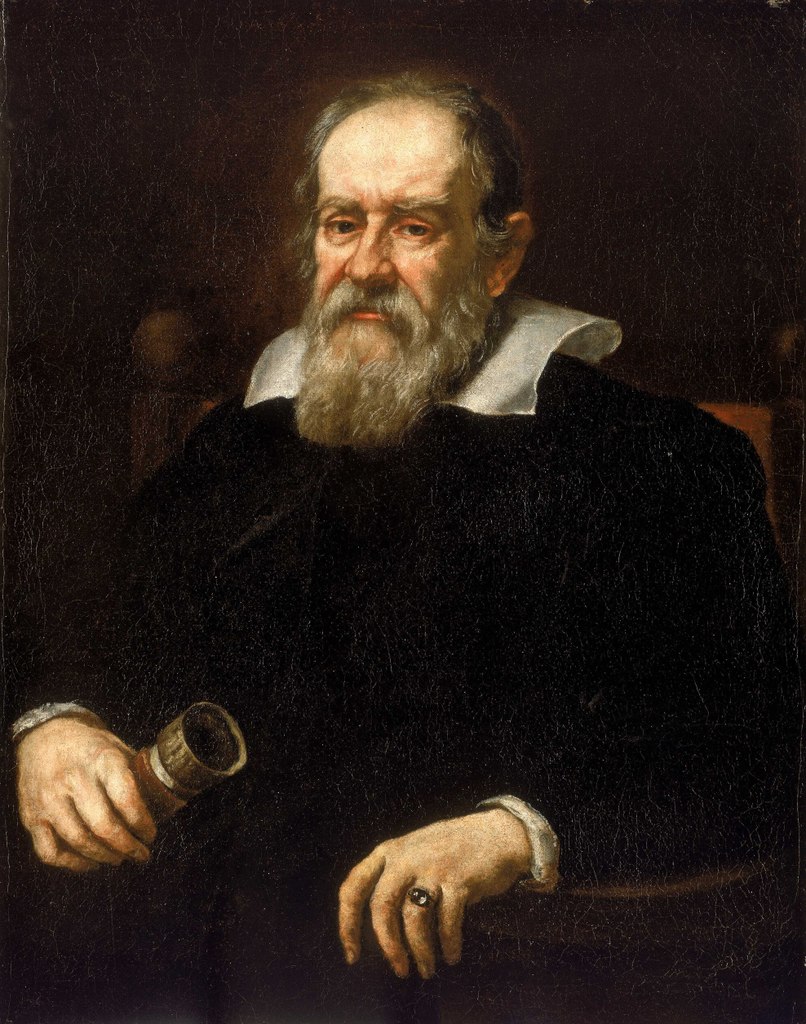
Galileo di Galilei (1564 – 1642), was an Italian astronomer, physicist and engineer, sometimes described as a polymath. He was born in the city of Pisa, then part of the Duchy of Florence. Galileo has been called the father of observational astronomy, modern-era classical physics, the scientific method, and modern science.
Galileo studied speed and velocity, gravity and free fall, the principle of relativity, inertia, projectile motion and also worked in applied science and technology, describing the properties of the pendulum and "hydrostatic balances". He was one of the earliest Renaissance developers of the thermoscope[13] and the inventor of various military compasses. With an improved telescope he built, he observed the stars of the Milky Way, the phases of Venus, the four largest satellites of Jupiter, Saturn's rings, lunar craters and sunspots. He also built an early microscope.
Galileo's championing of Copernican heliocentrism was met with opposition from within the Catholic Church and from some astronomers. The matter was investigated by the Roman Inquisition in 1615, which concluded that his opinions contradicted accepted Biblical interpretations.
Galileo later defended his views in Dialogue Concerning the Two Chief World Systems (1632), which appeared to attack and ridicule Pope Urban VIII, thus alienating both the Pope and the Jesuits, who had both strongly supported Galileo up until this point. He was tried by the Inquisition, found "vehemently suspect of heresy", and forced to recant. He spent the rest of his life under house arrest. During this time, he wrote Two New Sciences (1638), primarily concerning kinematics and the strength of materials.
Galileo: "I should disclose and publish to the world the occasion of discovering and observing four Planets, never seen from the beginning of the world up to our own times, their positions, and the observations made during the last two months about their movements and their changes of magnitude; and I summon all astronomers to apply themselves to examine and determine their periodic times, which it has not been permitted me to achieve up to this day . . . On the 7th day of January in the present year, 1610, in the first hour of the following night, when I was viewing the constellations of the heavens through a telescope, the planet Jupiter presented itself to my view, and as I had prepared for myself a very excellent instrument, I noticed a circumstance which I had never been able to notice before, namely that three little stars, small but very bright, were near the planet; and although I believed them to belong to a number of the fixed stars, yet they made me somewhat wonder, because they seemed to be arranged exactly in a straight line, parallel to the ecliptic, and to be brighter than the rest of the stars, equal to them in magnitude . . .When on January 8th, led by some fatality, I turned again to look at the same part of the heavens, I found a very different state of things, for there were three little stars all west of Jupiter, and nearer together than on the previous night." . . ."I therefore concluded, and decided unhesitatingly, that there are three stars in the heavens moving about Jupiter, as Venus and Mercury around the Sun; which was at length established as clear as daylight by numerous other subsequent observations. These observations also established that there are not only three, but four, erratic sidereal bodies performing their revolutions around Jupiter."
MATERIAL ON OUR WEBSITE
Chronology of the 17th century
Galileo biography
HIGHLY RECOMMENDED READING
I highly recommend this wonderful book to you and am delighted that it is now available in a paperback edition. It is a book that will capture your heart as you read of Galileo's extraordinary daughter Suor Maria Celeste and read her touching letters to her beloved father. We will visit her monastery on our Galileo night, so it will be a great night with beautiful pictures of the hills south of Florence where Galileo and his daughter lived their lives.
RECOMMENDED READING
Galileo on the World Systems: A New Abridged Translation and Guide,
University of California Press,
ISBN 978-0520206465
RECOMMENDED READING

26
Week 26: Thursday, May 7, 2026
Rousseau
Week 26
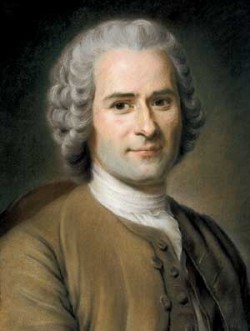
Jean-Jacques Rousseau, 28 June 1712 – 2 July 1778) was a Genevan philosopher, writer and composer. His political philosophy influenced the progress of the Enlightenment throughout Europe, as well as aspects of the French Revolution and the development of modern political, economic and educational thought. His Discourse on Inequality and The Social Contract are cornerstones in modern political and social thought. Rousseau's sentimental novel Julie, or the New Heloise (1761) was important to the development of Romanticism and Romanticism in fiction. His Emile, or On Education (1762) is an educational treatise on the place of the individual in society. Rousseau's autobiographical writings—the posthumously published Confessions (composed in 1769), which initiated the modern autobiography, and the unfinished Reveries of a Solitary Walker (composed 1776–1778)—exemplified the late-18th-century "Age of Sensibility", and featured an increased focus on subjectivity and introspection that later characterized modern writing.. During the period of the French Revolution, Rousseau was the most popular of the philosophers among members of the Jacobin Club. He was interred as a national hero in the Panthéon in Paris, in 1794, 16 years after his death.
(Wikipedia)
MATERIAL ON OUR WEBSITE
Chronology of the 18th century
Rousseau biography
REQUIRED READING
RECOMMENDED READING
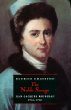
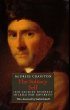
The best biography of Rousseau is written by an Englishman, (Can you imagine how the French hate that!) Maurice Cranston who devoted a lifetime to Rousseau and produced a brilliant biography at the end of his life. It is available in 3 softcover volumes. It is very readable, very well written. For our work the first volume is the most immediately useful but all three are worth reading at some point in your investigations into Romanticism.
Vol. 1: Jean-Jacques; the early Life and Work (1712-1754)
Vol. 2: The Noble Savage (1754-1762)
Vol. 3: The Solitary Self (1762-1778)
University of Chicago Press.
27
Week 27: Thursday, May 14, 2026
Byron
Week 27

The Poet and Romanticism
Byron's life
Byron's works: readings from his works, critical opinions
Importance of Byron in the Romantic Movement
MATERIAL ON OUR WEBSITE
Chronology of the 18th century
Byron page
Byron biography
Byron bibliography
Byron critical opinion: Please do not read the critical opinion until after class. We will read him ourselves before we read the critics.
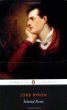
REQUIRED READING
RECOMMENDED READING
If you visit the Byron Bibliography you will see a number of excellent books on Byron, his wife, his daughter and his sister and other aspects of his fascinating story. If you would like one good biography to begin your extra reading on Byron, the Benita Eisler biography is a good choice.
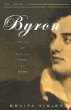
Byron: Child of Passion, Fool of Fame,
Vintage,
ISBN 0679740856
Here is a short review from Amazon: "In this masterful portrait of the poet who dazzled an era and prefigured the modern age of celebrity, noted biographer Benita Eisler offers a fuller and more complex vision than we have yet been afforded of George Gordon, Lord Byron. Eisler reexamines his poetic achievement in the context of his extraordinary life: the shameful and traumatic childhood; the swashbuckling adventures in the East; the instant stardom achieved with the publication of Childe Harold's Pilgrimage; his passionate and destructive love affairs and finally his tragic death in the cause of Greek independence. This magnificent record of a towering figure is sure to become the new standard biography of Byron."
28
Week 28: Thursday, May 21, 2026
John Stuart Mill and Liberty
Week 28
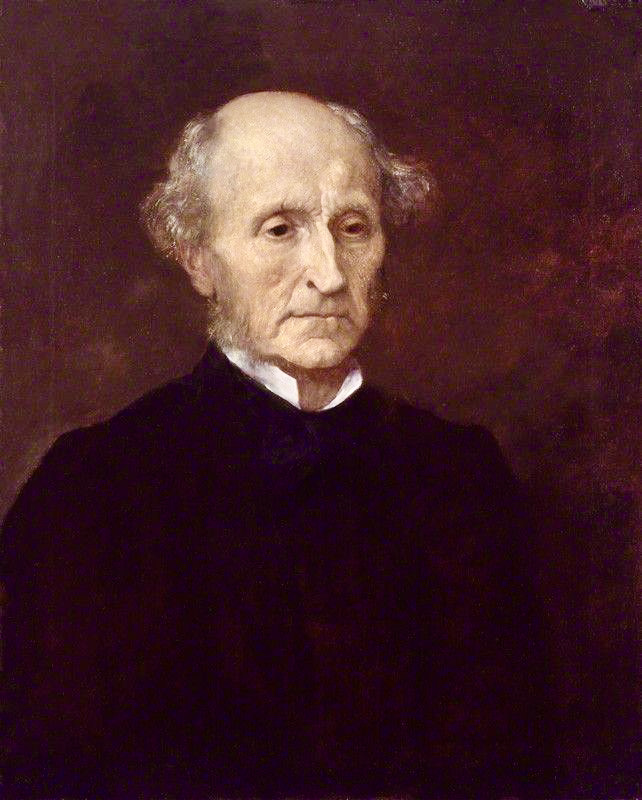
Why is John Stuart Mill so important?
Here is a quotation from a brilliant essay on Mill by Isaiah Berlin entitled John Stuart Mill and the Ends of Life:
"Mill is not interested in actuarial calculations. At the center of his thought and feeling lies, not his utilitarianism, nor the concern about enlightenment, nor about dividing the private from the public domain—but his attempt to fuse rationalism and romanticism; the aim of Goethe and Humboldt; a rich, spontaneous, many-sided, fearless, free, and yet rational, self-directed character. He perceived something profound and essential about the destructive effect of man's most successful efforts at self-improvement in modern society."
Berlin alerts us to the extraordinary insight of Mill as he lived through the mid-nineteenth century and contended with the two conflicting visions of the previous 100 years: Enlightenment Rationalism and Romantic emotionalism. This was the great debate of Voltaire and Rousseau. But now in 1850 you added trains and coal.
John Stuart Mill (20 May 1806 – 8 May 1873) was an English philosopher, political economist and civil servant. One of the most influential thinkers in the history of liberalism, he contributed widely to social theory, political theory and political economy. Dubbed "the most influential English-speaking philosopher of the nineteenth century", Mill's conception of liberty justified the freedom of the individual in opposition to unlimited state and social control. Mill was a proponent of utilitarianism, an ethical theory developed by his predecessor Jeremy Bentham, and contributed significantly to the theory of the scientific method. A member of the Liberal Party, he was also the first Member of Parliament to call for women's suffrage.
RECOMMENDED READING
John Stuart Mill: Victorian Firebrand,
Atlantic Books; Main edition (September 1, 2008),
ISBN 1843546442
RECOMMENDED READING
On Liberty and the Subjection of Women,
Penguin Classics; 1 edition (April 24, 2007),
ISBN 014144147X
29
Week 29: Thursday, May 28, 2026
Nietzsche and Dostoevsky
Week 29
Friedrich Wilhelm Nietzsche ( October 15, 1844–August 25, 1900) was a German philosopher, poet, composer, cultural critic, and classical philologist. He wrote critical texts on religion, morality, contemporary culture, philosophy, and science, displaying a fondness for metaphor, irony and aphorism. Nietzsche's key ideas include the death of God, the Übermensch, the eternal recurrence, the Apollonian and Dionysian dichotomy, and the will to power. Central to his philosophy is the idea of "life-affirmation," which involves questioning all doctrines that drain life's expansive energies, however socially prevalent and radical those views might be. His influence remains substantial within philosophy, notably in existentialism, post-modernism and post-structuralism, as well as outside it. His radical questioning of the value and objectivity of truth has been the focus of extensive commentary, especially in the continental tradition. Nietzsche has been called one of the masters of the "school of suspicion," alongside Karl Marx and Sigmund Freud. Nietzsche began his career as a classical philologist before turning to philosophy. In 1869, at the age of 24 he was appointed to the Chair of Classical Philology at the University of Basel (the youngest individual to have held this position), but resigned in the summer of 1879 due to health problems that plagued him most of his life. In 1889 he suffered a collapse and a complete loss of his mental faculties. The breakdown has been ascribed to an atypical general paralysis attributed to tertiary syphilis, but this diagnosis has since come into question. He lived his remaining years in the care of his mother until her death in 1897, and then under the care of his sister until his death in 1900.
Dostoevsky and Crime and Punishment
Crime and Punishment is a novel by the Russian author Fyodor Dostoevsky. It was first published in the literary journal The Russian Messenger in twelve monthly installments during 1866. It was later published in a single volume. This is the second of Dostoevsky's full-length novels following his return from ten years of exile in Siberia. Crime and Punishment is the first great novel of his "mature period" of writing.
Crime and Punishment focuses on the mental anguish and moral dilemmas of Rodion Romanovich Raskolnikov, an impoverished ex-student in St. Petersburg who formulates a plan to kill an unscrupulous pawnbroker for her cash. Raskolnikov argues that with the pawnbroker's money he can perform good deeds to counterbalance the crime, while ridding the world of a worthless vermin. He also plans this murder to test his own hypothesis that some people are naturally capable of such things, and even have the right to do them. Several times throughout the novel, Raskolnikov justifies his actions by connecting himself mentally with Napoleon Bonaparte, believing that murder is permissible in pursuit of a higher purpose.
MATERIAL ON OUR WEBSITE
REQUIRED READING
RECOMMENDED READING
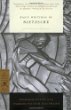
Basic Writings of Nietzsche,
Modern Library edition, 2000,
ISBN 9780679783398
Introduction by Peter Gay Translated and edited by Walter Kaufmann Commentary by Martin Heidegger, Albert Camus, and Gilles Deleuze. One hundred years after his death, Friedrich Nietzsche remains the most influential philosopher of the modern era. Basic Writings of Nietzsche gathers the complete texts of five of Nietzsche’s most important works, from his first book to his last: The Birth of Tragedy, Beyond Good and Evil, On the Genealogy of Morals, The Case of Wagner, and Ecce Homo. Edited and translated by the great Nietzsche scholar Walter Kaufmann, this volume also features seventy-five aphorisms, selections from Nietzsche’s correspondence, and variants from drafts for Ecce Homo. It is a definitive guide to the full range of Nietzsche’s thought.
30
Week 30: Thursday, June 4, 2026
The Western Tradition and the Twentieth Century
Week 30
In this thirtieth week of our study of the Western Tradition, we will look at the story of the twentieth Century and freedom. How did freedom advance or retreat during the twentieth Century? We begin at 1900, with the great Universal Exhibition at Paris to which fifty million people came. And we continue to look at the entire century all the way to 1990's and the fall of the Soviet Union, the fall of the Berlin Wall (Nov. 9, 1989), the birth of freedom in Poland, and the rest of Eastern Europe.
RECOMMENDED READING
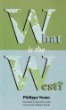
What is the West?,
Duquesne University Press (December 15, 2005),
ISBN 0820703753
Review:
In this short, illuminating, and very readable work, Philippe Nemo argues that what we call 'the West' is one and only one cultural entity, to which both North America and Western Europe belong. In contemporary debates, then, Nemo asserts, it is simply incorrect to exaggerate the differences or gaps between countries that are indeed 'Western'. Brilliantly and succinctly surveying the last five or six millenia, Nemo pieces together the history of the West's development. He weaves together political events, philosophical discoveries, religious movements, and scientific and technological innovations to demonstrate the factors that have influenced and shaped Western culture. Already translated from the original French into Portuguese, Italian, German and Greek, "What is the West?" has received considerable interest throughout Europe; earlier this year, in fact, it received the Italian 'Citte della Rose' prize for essays. Now available for the first time in English, this book will be essential reading for those interested in contemporary cultural debates on Western culture and nationhood, as well as American values; as well as those interested in world history and politics, philosophy and religion, and contemporary global politics. Not geared to specifically conservative or liberal viewpoints but to an accurate rendering of historical ideas and trends, Nemo's book should do much to advance our understanding of each other in an increasingly global community.
About the Author:
PHILIPPE NEMO is a professor at the ESCP-EAP European School of Management, where he teaches philosophy and the history of political ideas. He is also the author of Job and the Excess of Evil.
All
Week 21: Thu., Apr. 2, 2026
Christopher Columbus
Week 21
Christopher Columbus (October 1451 – 20 May 1506) His name in Italian: Cristoforo Colombo. In Catalan: Cristòfor Colom. In Spanish: Cristóbal Colón. In Portuguese: Cristóvão Colombo. In Latin: Christophorus Columbus. In Genoese: Christoffa Corombo
Christopher Columbus was a scholar, explorer, and navigator, born in the Republic of Genoa, in northwestern Italy. Under the auspices of Queen Isabella and King Ferdinand, he completed four voyages across the Atlantic Ocean that led to general European awareness of the American continents in the Western Hemisphere. Those voyages, and his efforts to establish permanent settlements in the island of Hispaniola, initiated the process of Spanish colonization, which foreshadowed the general European colonization of the New World.
In the context of emerging western imperialism and economic competition between European kingdoms seeking wealth through the establishment of trade routes and colonies, Columbus' proposal to reach the East Indies by sailing westward received the support of the Spanish crown, which saw in it a promise, however remote, of gaining the upper hand over rival powers in the contest for the lucrative spice trade with Asia.
During his first voyage in 1492, instead of reaching the Indies as he had intended, Columbus landed in the Bahamas archipelago, at a locale he named San Salvador. Over the course of three more voyages, Columbus visited the Greater and Lesser Antilles, as well as the Caribbean coast of Colombia, Venezuela and Central America, claiming them for the Spanish Empire.
Columbus' voyages led to the first lasting European contact with America, inaugurating a period of European exploration and colonization of foreign lands that lasted for several centuries. They had, therefore, an enormous impact in the historical development of the modern Western world. Columbus himself saw his accomplishments primarily in the light of the spreading of the Christian religion. Never admitting that he had reached a continent previously unknown to Europeans, rather than the Indies he had set out for, Columbus called the inhabitants of the lands he visited indios (Spanish for "Indians").
Columbus' strained relationship with the Spanish crown and its appointed colonial administrators in America led to his arrest and dismissal as governor of the settlements in Hispaniola in 1500, and later to protracted litigation over the benefits which Columbus and his heirs claimed were owed to them by the crown.
REQUIRED READING:
Read the "Introduction" and the First Voyage
The Four Voyages: Being His Own Log-Book, Letters and Dispatches with Connecting Narratives,
Penguin Classic,
ISBN 0140442170
RECOMMENDED READING:
Here is a new biography of Columbus, the first new one in English in sixty years, and you will enjoy it and learn a lot. It is also available in new quality paperback from Penguin.
Laurence Bergreen's ambitious new biography, Columbus: The Four Voyages [is] a spellbinding epic that's simultaneiously a profoundly private portrait of the most complex, compelling, controversial creature ever to board a boat. This scrupulously researched, unbiased account of four death-defying journeys to The New World reveals the Admiral's paradoxical personality."
— USA Today
Week 22: Thu., Apr. 9, 2026
Martin Luther
Week 22
Martin Luther (1483-1546) was a German priest, theologian, author, hymnwriter, professor, and former Augustinian friar. Luther was the seminal figure of the Protestant Reformation, and his theological beliefs form the basis of Lutheranism. He is widely regarded as one of the most influential figures in Western and Christian history.
Born in Eisleben, Luther was ordained to the priesthood in 1507. He came to reject several teachings and practices of the contemporary Roman Catholic Church, in particular the view on indulgences and papal authority. Luther initiated an international debate on these in e.g. his Ninety-five Theses, which he authored in 1517. In 1520, Pope Leo X demanded that Luther renounce all of his writings, and when Luther refused to do so, excommunicated him in January 1521. Later that year, Holy Roman Emperor Charles V condemned Luther as an outlaw at the Diet of Worms. When Luther died in 1546, his excommunication by Leo X was still in effect.
Luther taught that justification is not earned by any human acts or intents or merit; rather, it is received only as the free gift of God's grace through the believer's faith in Jesus Christ. He held that good works were a necessary fruit of living faith, part of the process of sanctification. Luther's theology challenged the authority and office of the pope and bishops by teaching that the Bible is the only source of divinely revealed knowledge on the Gospel, and opposed sacerdotalism by considering all baptized Christians to be a holy priesthood. Those who identify with these, as well as Luther's wider teachings, are called Lutherans, although Luther insisted on Christian or Evangelical (German: evangelisch), as the only acceptable names for individuals who professed Christ.
Luther's translation of the Bible from Latin into German made the Bible vastly more accessible to the laity, which had a tremendous impact on both the church and German culture. It fostered the development of a standard version of the German language, added several principles to the art of translation, and influenced the writing of an English translation, the Tyndale Bible. His hymns influenced the development of singing in Protestant churches. His marriage to Katharina von Bora, a former nun, set a model for the practice of clerical marriage, allowing Protestant clergy to marry.
(Wikipedia)
MATERIAL ON THE WEB
Chronology of the 15th century
Chronology of the 16th century
Biography of Martin Luther
REQUIRED READING
The Ninety-Five Theses
RECOMMENDED READING
The biography of Luther that everyone should own is the one book on Luther that has dominated all studies of Luther in the United States for the last fifty years. It is the work of Roland Bainton, the Titus Street Professor of Ecclesiastical History at Yale for almost half a century. Bainton was the professor of my professor, Lewis Spitz. So I am his academic "grandson." Bainton's biography of Luther is still in print fifty five years after its first publication. It's a complete bargain in hardcover, at $14.
RECOMMENDED READING: NEW BOOK ON LUTHER
Martin Luther: The Man Who Rediscovered God and Changed the World,
Viking; First Edition edition (October 3, 2017),
ISBN 110198001X
Week 23: Thu., Apr. 16, 2026
Rembrandt
Week 23
Rembrandt Harmenszoon van Rijn (1606 – 1669), was a Dutch Golden Age painter, printmaker, and draughtsman. He is generally considered one of the greatest visual artists in the history of Western art. It is estimated that Rembrandt's surviving works amount to about three hundred paintings, three hundred etchings and several hundred drawings.
Unlike most Dutch painters of the 17th century, Rembrandt's works depict a wide range of styles and subject matter, from portraits and self-portraits to landscapes, genre scenes, allegorical and historical scenes, biblical and mythological subjects and animal studies. His contributions to art came in a period that historians call the Dutch Golden Age.
Rembrandt never went abroad but was considerably influenced by the work of the Italian Old Masters and Dutch and Flemish artists who had studied in Italy. After he achieved youthful success as a portrait painter, Rembrandt's later years were marked by personal tragedy and financial hardships. Yet his etchings and paintings were popular throughout his lifetime, his reputation as an artist remained high, and for twenty years he taught many important Dutch painters. Rembrandt's portraits of his contemporaries, self-portraits and illustrations of scenes from the Bible are regarded as his greatest creative triumphs. His approximately 40 self-portraits form an intimate autobiography.
MATERIAL ON THE WEB
Chronology of the 17th century
Rembrandt page
Rembrandt biography
REQUIRED READING
No required reading
Week 24: Thu., Apr. 23, 2026
Birth of Modern Science
Week 24
We can cite many steps in the history of Western Civilization that led to today's modern science. The Greeks, of course, began simple experimental science. We can think of Euclid, and of Ptolemy and the experiments he carried out in the Egyptian desert to calculate the size of the earth. Later, Islamic centers pursued experimental science, especially mathematical. Medieval philosophers such as Roger Bacon understood empirical science.
In the early 1400's, a scientific center at the Florentine Cathedral experimented and achieved some sophisticated research under the leadership of many Florentine philosophers, as well as Brunelleschi and other artists.
Lacking in all of these earlier phases of science were three essential aspects of modern science: 1) devices such as the microscope, developed specifically to be used in discovery and experimentation; 2) A publicly chartered institution, with its own building, established for and dedicated to science; and 3) a scientific publication. These three new features of modern science appeared in England in the 1660s, during the monarchy of Charles II.
RECOMMENDED READING
This book based on lectures delivered earlier, was first published in 1957. There have been many other books since then on this subject, but Butterfield is still the right place to begin. A great book and still in print.
The Origins of Modern Science,
Free Press; Revised edition (April 1, 1997),
ISBN 0684836378
Review:
Superb Book September 29, 2003 By Benjamin B. Eshbach Format:Paperback
Professor Butterfield's history is easy to read and refreshing. Especially interesting are his chapters on pre-Newtonian mechanics and the transfer from Ptolemaic to Copernican models of the universe.
Week 25: Thu., Apr. 30, 2026
Galileo
Week 25
Galileo di Galilei (1564 – 1642), was an Italian astronomer, physicist and engineer, sometimes described as a polymath. He was born in the city of Pisa, then part of the Duchy of Florence. Galileo has been called the father of observational astronomy, modern-era classical physics, the scientific method, and modern science.
Galileo studied speed and velocity, gravity and free fall, the principle of relativity, inertia, projectile motion and also worked in applied science and technology, describing the properties of the pendulum and "hydrostatic balances". He was one of the earliest Renaissance developers of the thermoscope[13] and the inventor of various military compasses. With an improved telescope he built, he observed the stars of the Milky Way, the phases of Venus, the four largest satellites of Jupiter, Saturn's rings, lunar craters and sunspots. He also built an early microscope.
Galileo's championing of Copernican heliocentrism was met with opposition from within the Catholic Church and from some astronomers. The matter was investigated by the Roman Inquisition in 1615, which concluded that his opinions contradicted accepted Biblical interpretations.
Galileo later defended his views in Dialogue Concerning the Two Chief World Systems (1632), which appeared to attack and ridicule Pope Urban VIII, thus alienating both the Pope and the Jesuits, who had both strongly supported Galileo up until this point. He was tried by the Inquisition, found "vehemently suspect of heresy", and forced to recant. He spent the rest of his life under house arrest. During this time, he wrote Two New Sciences (1638), primarily concerning kinematics and the strength of materials.
Galileo: "I should disclose and publish to the world the occasion of discovering and observing four Planets, never seen from the beginning of the world up to our own times, their positions, and the observations made during the last two months about their movements and their changes of magnitude; and I summon all astronomers to apply themselves to examine and determine their periodic times, which it has not been permitted me to achieve up to this day . . . On the 7th day of January in the present year, 1610, in the first hour of the following night, when I was viewing the constellations of the heavens through a telescope, the planet Jupiter presented itself to my view, and as I had prepared for myself a very excellent instrument, I noticed a circumstance which I had never been able to notice before, namely that three little stars, small but very bright, were near the planet; and although I believed them to belong to a number of the fixed stars, yet they made me somewhat wonder, because they seemed to be arranged exactly in a straight line, parallel to the ecliptic, and to be brighter than the rest of the stars, equal to them in magnitude . . .When on January 8th, led by some fatality, I turned again to look at the same part of the heavens, I found a very different state of things, for there were three little stars all west of Jupiter, and nearer together than on the previous night." . . ."I therefore concluded, and decided unhesitatingly, that there are three stars in the heavens moving about Jupiter, as Venus and Mercury around the Sun; which was at length established as clear as daylight by numerous other subsequent observations. These observations also established that there are not only three, but four, erratic sidereal bodies performing their revolutions around Jupiter."
MATERIAL ON OUR WEBSITE
Chronology of the 17th century
Galileo biography
HIGHLY RECOMMENDED READING
I highly recommend this wonderful book to you and am delighted that it is now available in a paperback edition. It is a book that will capture your heart as you read of Galileo's extraordinary daughter Suor Maria Celeste and read her touching letters to her beloved father. We will visit her monastery on our Galileo night, so it will be a great night with beautiful pictures of the hills south of Florence where Galileo and his daughter lived their lives.
RECOMMENDED READING
Galileo on the World Systems: A New Abridged Translation and Guide,
University of California Press,
ISBN 978-0520206465
RECOMMENDED READING
Week 26: Thu., May. 7, 2026
Rousseau
Week 26
Jean-Jacques Rousseau, 28 June 1712 – 2 July 1778) was a Genevan philosopher, writer and composer. His political philosophy influenced the progress of the Enlightenment throughout Europe, as well as aspects of the French Revolution and the development of modern political, economic and educational thought. His Discourse on Inequality and The Social Contract are cornerstones in modern political and social thought. Rousseau's sentimental novel Julie, or the New Heloise (1761) was important to the development of Romanticism and Romanticism in fiction. His Emile, or On Education (1762) is an educational treatise on the place of the individual in society. Rousseau's autobiographical writings—the posthumously published Confessions (composed in 1769), which initiated the modern autobiography, and the unfinished Reveries of a Solitary Walker (composed 1776–1778)—exemplified the late-18th-century "Age of Sensibility", and featured an increased focus on subjectivity and introspection that later characterized modern writing.. During the period of the French Revolution, Rousseau was the most popular of the philosophers among members of the Jacobin Club. He was interred as a national hero in the Panthéon in Paris, in 1794, 16 years after his death.
(Wikipedia)
MATERIAL ON OUR WEBSITE
Chronology of the 18th century
Rousseau biography
REQUIRED READING
RECOMMENDED READING
The best biography of Rousseau is written by an Englishman, (Can you imagine how the French hate that!) Maurice Cranston who devoted a lifetime to Rousseau and produced a brilliant biography at the end of his life. It is available in 3 softcover volumes. It is very readable, very well written. For our work the first volume is the most immediately useful but all three are worth reading at some point in your investigations into Romanticism.
Vol. 1: Jean-Jacques; the early Life and Work (1712-1754)
Vol. 2: The Noble Savage (1754-1762)
Vol. 3: The Solitary Self (1762-1778)
University of Chicago Press.
Week 27: Thu., May. 14, 2026
Byron
Week 27
The Poet and Romanticism
Byron's life
Byron's works: readings from his works, critical opinions
Importance of Byron in the Romantic Movement
MATERIAL ON OUR WEBSITE
Chronology of the 18th century
Byron page
Byron biography
Byron bibliography
Byron critical opinion: Please do not read the critical opinion until after class. We will read him ourselves before we read the critics.
REQUIRED READING
RECOMMENDED READING
If you visit the Byron Bibliography you will see a number of excellent books on Byron, his wife, his daughter and his sister and other aspects of his fascinating story. If you would like one good biography to begin your extra reading on Byron, the Benita Eisler biography is a good choice.
Byron: Child of Passion, Fool of Fame,
Vintage,
ISBN 0679740856
Here is a short review from Amazon: "In this masterful portrait of the poet who dazzled an era and prefigured the modern age of celebrity, noted biographer Benita Eisler offers a fuller and more complex vision than we have yet been afforded of George Gordon, Lord Byron. Eisler reexamines his poetic achievement in the context of his extraordinary life: the shameful and traumatic childhood; the swashbuckling adventures in the East; the instant stardom achieved with the publication of Childe Harold's Pilgrimage; his passionate and destructive love affairs and finally his tragic death in the cause of Greek independence. This magnificent record of a towering figure is sure to become the new standard biography of Byron."
Week 28: Thu., May. 21, 2026
John Stuart Mill and Liberty
Week 28
Why is John Stuart Mill so important?
Here is a quotation from a brilliant essay on Mill by Isaiah Berlin entitled John Stuart Mill and the Ends of Life:
"Mill is not interested in actuarial calculations. At the center of his thought and feeling lies, not his utilitarianism, nor the concern about enlightenment, nor about dividing the private from the public domain—but his attempt to fuse rationalism and romanticism; the aim of Goethe and Humboldt; a rich, spontaneous, many-sided, fearless, free, and yet rational, self-directed character. He perceived something profound and essential about the destructive effect of man's most successful efforts at self-improvement in modern society."
Berlin alerts us to the extraordinary insight of Mill as he lived through the mid-nineteenth century and contended with the two conflicting visions of the previous 100 years: Enlightenment Rationalism and Romantic emotionalism. This was the great debate of Voltaire and Rousseau. But now in 1850 you added trains and coal.
John Stuart Mill (20 May 1806 – 8 May 1873) was an English philosopher, political economist and civil servant. One of the most influential thinkers in the history of liberalism, he contributed widely to social theory, political theory and political economy. Dubbed "the most influential English-speaking philosopher of the nineteenth century", Mill's conception of liberty justified the freedom of the individual in opposition to unlimited state and social control. Mill was a proponent of utilitarianism, an ethical theory developed by his predecessor Jeremy Bentham, and contributed significantly to the theory of the scientific method. A member of the Liberal Party, he was also the first Member of Parliament to call for women's suffrage.
RECOMMENDED READING
John Stuart Mill: Victorian Firebrand,
Atlantic Books; Main edition (September 1, 2008),
ISBN 1843546442
RECOMMENDED READING
On Liberty and the Subjection of Women,
Penguin Classics; 1 edition (April 24, 2007),
ISBN 014144147X
Week 28: Thu., May. 24, 2018
Nietzsche: Beyond Good and Evil
LECTURE
Wikipedia on Nietzsche:
Friedrich Wilhelm Nietzsche ( October 15, 1844–August 25, 1900) was a German philosopher, poet, composer, cultural critic, and classical philologist. He wrote critical texts on religion, morality, contemporary culture, philosophy, and science, displaying a fondness for metaphor, irony and aphorism. Nietzsche's key ideas include the death of God, the Übermensch, the eternal recurrence, the Apollonian and Dionysian dichotomy, and the will to power. Central to his philosophy is the idea of "life-affirmation," which involves questioning all doctrines that drain life's expansive energies, however socially prevalent and radical those views might be. His influence remains substantial within philosophy, notably in existentialism, post-modernism and post-structuralism, as well as outside it. His radical questioning of the value and objectivity of truth has been the focus of extensive commentary, especially in the continental tradition. Nietzsche has been called one of the masters of the "school of suspicion," alongside Karl Marx and Sigmund Freud. Nietzsche began his career as a classical philologist before turning to philosophy. In 1869, at the age of 24 he was appointed to the Chair of Classical Philology at the University of Basel (the youngest individual to have held this position), but resigned in the summer of 1879 due to health problems that plagued him most of his life. In 1889 he suffered a collapse and a complete loss of his mental faculties. The breakdown has been ascribed to an atypical general paralysis attributed to tertiary syphilis, but this diagnosis has since come into question. He lived his remaining years in the care of his mother until her death in 1897, and then under the care of his sister until his death in 1900.
28motwm.5.24.18
RECOMMENDED READING
Basic Writings of Nietzsche,
Modern Library edition, 2000,
ISBN 9780679783398
Introduction by Peter Gay Translated and edited by Walter Kaufmann Commentary by Martin Heidegger, Albert Camus, and Gilles Deleuze. One hundred years after his death, Friedrich Nietzsche remains the most influential philosopher of the modern era. Basic Writings of Nietzsche gathers the complete texts of five of Nietzsche’s most important works, from his first book to his last: The Birth of Tragedy, Beyond Good and Evil, On the Genealogy of Morals, The Case of Wagner, and Ecce Homo. Edited and translated by the great Nietzsche scholar Walter Kaufmann, this volume also features seventy-five aphorisms, selections from Nietzsche’s correspondence, and variants from drafts for Ecce Homo. It is a definitive guide to the full range of Nietzsche’s thought.
Week 29: Thu., May. 28, 2026
Nietzsche and Dostoevsky
Week 29
Friedrich Wilhelm Nietzsche ( October 15, 1844–August 25, 1900) was a German philosopher, poet, composer, cultural critic, and classical philologist. He wrote critical texts on religion, morality, contemporary culture, philosophy, and science, displaying a fondness for metaphor, irony and aphorism. Nietzsche's key ideas include the death of God, the Übermensch, the eternal recurrence, the Apollonian and Dionysian dichotomy, and the will to power. Central to his philosophy is the idea of "life-affirmation," which involves questioning all doctrines that drain life's expansive energies, however socially prevalent and radical those views might be. His influence remains substantial within philosophy, notably in existentialism, post-modernism and post-structuralism, as well as outside it. His radical questioning of the value and objectivity of truth has been the focus of extensive commentary, especially in the continental tradition. Nietzsche has been called one of the masters of the "school of suspicion," alongside Karl Marx and Sigmund Freud. Nietzsche began his career as a classical philologist before turning to philosophy. In 1869, at the age of 24 he was appointed to the Chair of Classical Philology at the University of Basel (the youngest individual to have held this position), but resigned in the summer of 1879 due to health problems that plagued him most of his life. In 1889 he suffered a collapse and a complete loss of his mental faculties. The breakdown has been ascribed to an atypical general paralysis attributed to tertiary syphilis, but this diagnosis has since come into question. He lived his remaining years in the care of his mother until her death in 1897, and then under the care of his sister until his death in 1900.
Dostoevsky and Crime and Punishment
Crime and Punishment is a novel by the Russian author Fyodor Dostoevsky. It was first published in the literary journal The Russian Messenger in twelve monthly installments during 1866. It was later published in a single volume. This is the second of Dostoevsky's full-length novels following his return from ten years of exile in Siberia. Crime and Punishment is the first great novel of his "mature period" of writing.
Crime and Punishment focuses on the mental anguish and moral dilemmas of Rodion Romanovich Raskolnikov, an impoverished ex-student in St. Petersburg who formulates a plan to kill an unscrupulous pawnbroker for her cash. Raskolnikov argues that with the pawnbroker's money he can perform good deeds to counterbalance the crime, while ridding the world of a worthless vermin. He also plans this murder to test his own hypothesis that some people are naturally capable of such things, and even have the right to do them. Several times throughout the novel, Raskolnikov justifies his actions by connecting himself mentally with Napoleon Bonaparte, believing that murder is permissible in pursuit of a higher purpose.
MATERIAL ON OUR WEBSITE
REQUIRED READING
RECOMMENDED READING
Basic Writings of Nietzsche,
Modern Library edition, 2000,
ISBN 9780679783398
Introduction by Peter Gay Translated and edited by Walter Kaufmann Commentary by Martin Heidegger, Albert Camus, and Gilles Deleuze. One hundred years after his death, Friedrich Nietzsche remains the most influential philosopher of the modern era. Basic Writings of Nietzsche gathers the complete texts of five of Nietzsche’s most important works, from his first book to his last: The Birth of Tragedy, Beyond Good and Evil, On the Genealogy of Morals, The Case of Wagner, and Ecce Homo. Edited and translated by the great Nietzsche scholar Walter Kaufmann, this volume also features seventy-five aphorisms, selections from Nietzsche’s correspondence, and variants from drafts for Ecce Homo. It is a definitive guide to the full range of Nietzsche’s thought.
Week 30: Thu., Jun. 4, 2026
The Western Tradition and the Twentieth Century
Week 30
In this thirtieth week of our study of the Western Tradition, we will look at the story of the twentieth Century and freedom. How did freedom advance or retreat during the twentieth Century? We begin at 1900, with the great Universal Exhibition at Paris to which fifty million people came. And we continue to look at the entire century all the way to 1990's and the fall of the Soviet Union, the fall of the Berlin Wall (Nov. 9, 1989), the birth of freedom in Poland, and the rest of Eastern Europe.
RECOMMENDED READING
What is the West?,
Duquesne University Press (December 15, 2005),
ISBN 0820703753
Review:
In this short, illuminating, and very readable work, Philippe Nemo argues that what we call 'the West' is one and only one cultural entity, to which both North America and Western Europe belong. In contemporary debates, then, Nemo asserts, it is simply incorrect to exaggerate the differences or gaps between countries that are indeed 'Western'. Brilliantly and succinctly surveying the last five or six millenia, Nemo pieces together the history of the West's development. He weaves together political events, philosophical discoveries, religious movements, and scientific and technological innovations to demonstrate the factors that have influenced and shaped Western culture. Already translated from the original French into Portuguese, Italian, German and Greek, "What is the West?" has received considerable interest throughout Europe; earlier this year, in fact, it received the Italian 'Citte della Rose' prize for essays. Now available for the first time in English, this book will be essential reading for those interested in contemporary cultural debates on Western culture and nationhood, as well as American values; as well as those interested in world history and politics, philosophy and religion, and contemporary global politics. Not geared to specifically conservative or liberal viewpoints but to an accurate rendering of historical ideas and trends, Nemo's book should do much to advance our understanding of each other in an increasingly global community.
About the Author:
PHILIPPE NEMO is a professor at the ESCP-EAP European School of Management, where he teaches philosophy and the history of political ideas. He is also the author of Job and the Excess of Evil.