Week 3
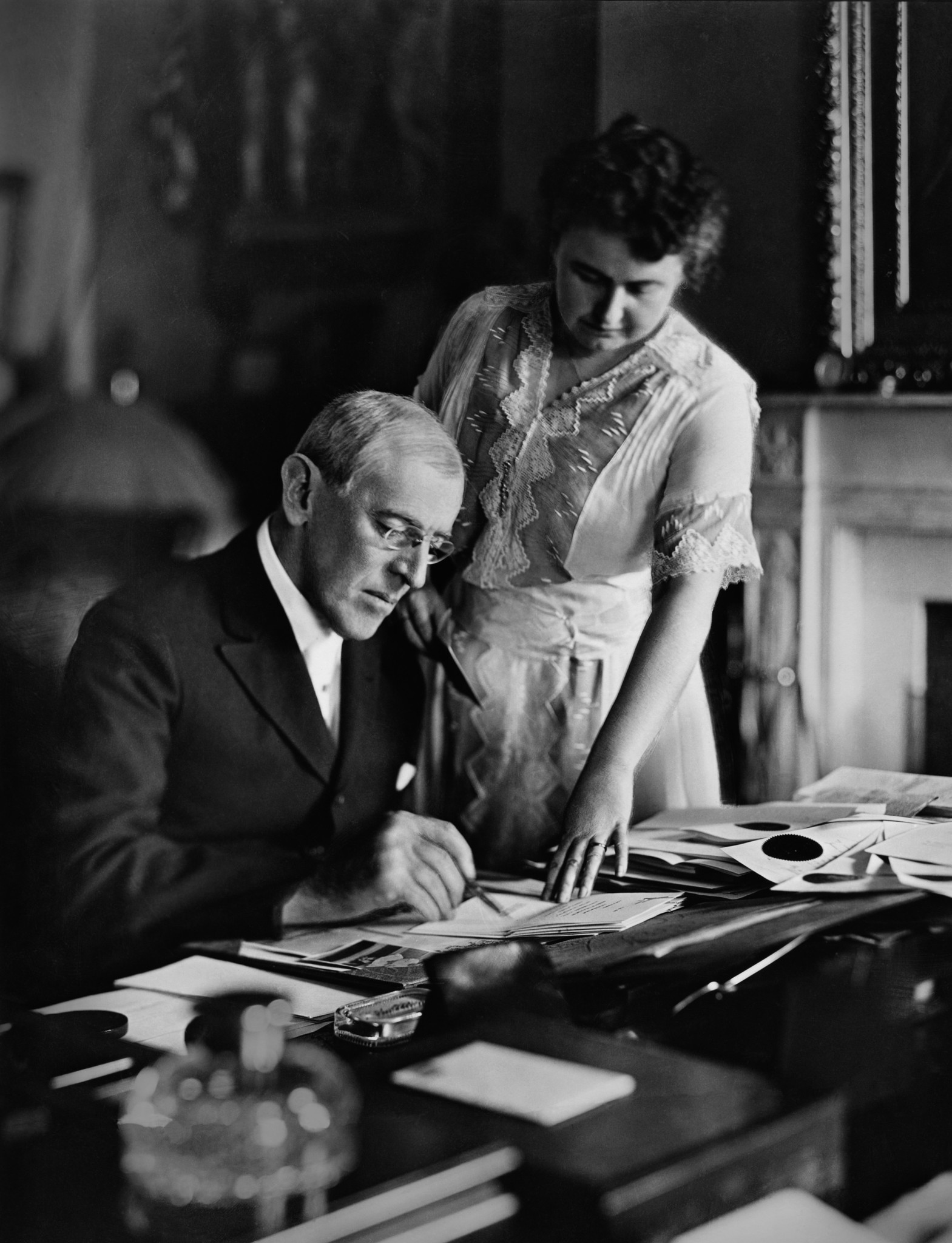
Woodrow Wilson 1856-1924
President Woodrow Wilson dedicated to pursuing a program of progressive domestic reform ("the New Freedom") saw the outbreak of war in Europe as a threat to his plans. In December 1914, he declared that the United States should not let itself be "thrown off balance" by a war "with which we have nothing to do, whose causes cannot touch us." "He kept us out of the war" was Wilson's campaign slogan in the presidential election of 1916, an election in which he narrowly defeated the Republican candidate, Charles Evans Hughes. Ever since George Washington had warned Americans against "foreign entanglements," isolationism had been as American as apple pie. And the slaughter on the Western Front had certainly not whetted Americans' appetite for intervention in the war. "There is such a thing as a man being too proud to fight," Wilson opined. "There is such a thing as a nation being so right that it does not need to convince others by force that it is right." The bellicose former president, Theodore Roosevelt, mocked Wilson's "too proud to fight" rhetoric and accused the president of cowardice. Wilson, he thundered, was a "demagogue, adroit, tricky, false, without one spark of loftiness in him, without a touch of the heroic in his cold, selfish and timid soul." He likened the president to Pontius Pilate, then apologized to Pilate. "We are passing through a thick streak of yellow in our national life." Born in Virginia in 1856, Wilson was nine years old when the American Civil War ended. He did not experience it as Lincoln defined it: as an epic struggle to reaffirm the principle that "government by the people, and for the people shall not perish from the earth," and certainly not as a successful effort to free an enslaved people and to remove the taint of slavery from the American republic. "To Wilson, it was a war of unwarranted destruction, of occupation and degradation of his beloved South. When he was fourteen, the Wilson family moved to a devastated Columbia, South Carolina, which Yankee soldiers had all but burned to the ground five years later. The Civil War left him with a deep, abiding horror of war itself. Wilson worried that if America were dragged into war for the wrong reasons, it would ignite an enthusiasm for war and violence like the emotion that has swept the North during the Civil War. This was why it was important in the days following the Lusitania's sinking to keep America cool and levelheaded" (Arthur Herman, 1917: Lenin, Wilson, and the Birth of the New World Disorder). How then, did Wilson win an election by promising to keep American out of the Great War, and then almost immediately find himself leading the country into it? Wilson had made two key decisions early in his first term, which brought the United States into closer relation with Britain and France, in spite of his insistence on American neutrality. "By permitting extension of commercial credit he enabled the Allies to buy supplies in America from which the Central Powers, by virtue of Allied control of the seas, were largely cut off. It opened an explosive expansion in American manufacture, trade, and foreign investments and bent the national economy to the same side in the war as prevailing popular sentiment" [in favor of the Allies] (Barbara Tuchman, "How We Entered World War I," in Practicing History).
RECOMMENDED READING
“A brilliant biography that still resonates in Washington today.”—Doris Kearns Goodwin
From Pulitzer Prize–winning, #1 New York Times–bestselling author A. Scott Berg comes the definitive—and revelatory—biography of one of the great American figures of modern times. One hundred years after his inauguration, Woodrow Wilson still stands as one of the most influential figures of the twentieth century, and one of the most enigmatic. And now, after more than a decade of research and writing, Pulitzer Prize-winning author A. Scott Berg has completed Wilson--the most personal and penetrating biography ever written about the 28th President. In addition to the hundreds of thousands of documents in the Wilson Archives, Berg was the first biographer to gain access to two recently-discovered caches of papers belonging to those close to Wilson. From this material, Berg was able to add countless details--even several unknown events--that fill in missing pieces of Wilson’s character and cast new light on his entire life. From the scholar-President who ushered the country through its first great world war to the man of intense passion and turbulence , from the idealist determined to make the world “safe for democracy” to the stroke-crippled leader whose incapacity and the subterfuges around it were among the century’s greatest secrets, the result is an intimate portrait written with a particularly contemporary point of view – a book at once magisterial and deeply emotional about the whole of Wilson’s life, accomplishments, and failings. This is not just Wilson the icon – but Wilson the man.