Week 4
The Great War of 1914–18 was the primal tragedy of modern world civilization, the main reason why the 20th century turned into such a disastrous epoch for mankind. The United States became a great power in the decades after the Civil War, and even an imperial power in 1898. But it was not yet a world power in the sense that it regularly conferred with the major European states, known as ‘the powers,’and took part in their diplomatic arrangements. America was not an isolated power—was never at any time, it can be argued, isolationist—and had always had global dealings from its Republican inception. But it had prudently kept clear of the internal wrangles of Europe (as had Britain until 1903), and held itself well aloof from both the Entente Cordiale of Britain and France, with its links, through France, with Tsarist Russia, an anti-semitic autocracy held in abhorrence by most Americans, and with the militaristic, Teutonic, and to some extent racist alliance of the Central European powers, the German and Austro-Hungarian empires. Thus the United States was a mere spectator during the frantic events which followed the murder of the Archduke Franz-Ferdinand of Austria on June 18, 1914, the Austrian ultimatum to Serbia, the Russian decision to support the Serbs, the French decision to support Russia, the German decision to support Austria and fight a two-front war against Russia and France, and Germany’s consequential decision to send its armies through Belgium to enforce quick defeat on the French, and so the involvement of Britain and its dominion allies in support of Belgium. No one in Europe took any notice of Wilson’s offer to mediate. The United States had no quarrel with Germany: quite the contrary. As early as 1785 it had negotiated a commercial treaty with Prussia, at which time immigrants of German origin already constituted 9 percent of the population. The Prussians backed the Union during the Civil War and the United States looked with approval on the emergence of a united Germany. But from the 1870s on, economic, commercial, colonial, and even naval rivalry endangered German-American relations, especially in the Pacific. There was a sharp dispute over Samoa, which did not end until the territory was partitioned in 1899, and which left a legacy of suspicion. America began to dislike Germany for exactly the same reasons as the British did: the arrogance and naive pushiness with which the Germans, latecomers to global naval power and colonialism, sought their own ‘place in the sun.’ In 1898, for instance, the Americans interpreted the presence of a strong German naval squadron near the Philippines as evidence of designs upon the islands. In the growing Anglo-German antagonism of 1900–14, the Special Relationship of Britain and America operated powerfully in Britain’s favor. It is significant that in 1902, when both Germany and Britain punished Venezuela for reneging on its debts, President Roosevelt’s administration criticized Germany but not Britain for violating the Monroe Doctrine. All the same, there was at first no question of America entering the war. On August 4, immediately after it began, Wilson issued a proclamation of neutrality. Two weeks later he urged Americans to be ‘impartial in thought as well as in action.’
RECOMMENDED READING
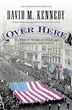
The Great War of 1914-1918 confronted the United States with one of the most wrenching crises in the nation's history. It also left a residue of disruption and disillusion that spawned an even more ruinous conflict scarcely a generation later. Over Here is the single-most comprehensive discussion of the impact of World War I on American society. This 25th anniversary edition includes a new afterword from Pulitzer Prize-winning author David M. Kennedy, that explains his reasons for writing the original edition as well as his opinions on the legacy of Wilsonian idealism, most recently reflected in President George W. Bush's national security strategy. More than a chronicle of the war years, Over Here uses the record of America's experience in the Great War as a prism through which to view early twentieth century American society. The ways in which America mobilized for the war, chose to fight it, and then went about the business of enshrining it in memory all indicate important aspects of enduring American character. An American history classic, Over Here reflects on a society's struggle with the pains of war, and offers trenchant insights into the birth of modern America.