Week 1
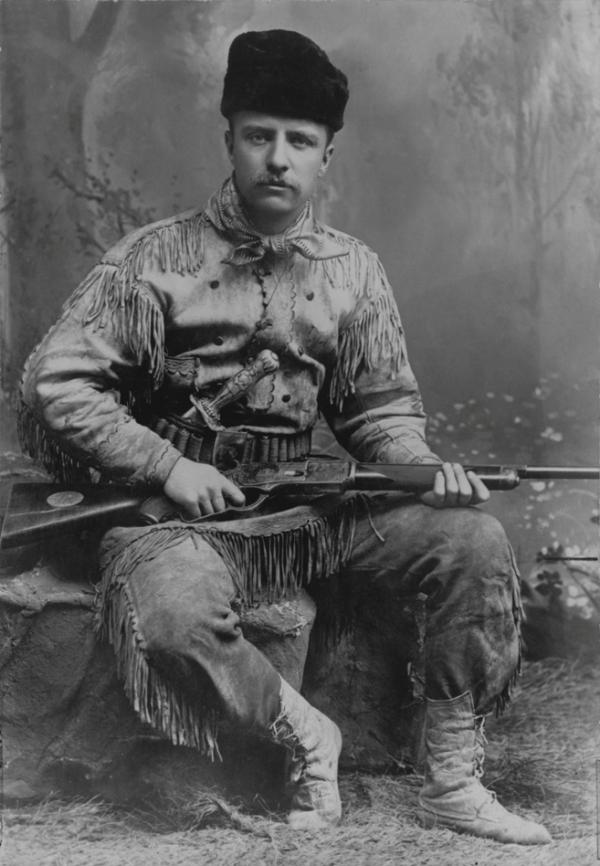
Theodore Roosevelt 1858-1919
TR was a sickly child, an anxious youth and young man, and when his young wife died leaving him a twenty-five-year-old widower with a child, he went out to the Badlands of Dakota, to heal and find himself (1884). Calling it the Badlands was a typical 19th-century topographical moral judgment (though it is true that the French, who were there first, baptized them mauvaise terres à traverser). It was indeed a Deathscape, actually strewn with buffalo skulls and bones. Below the buttes were mazes of quicksands and connecting gullies and abysses, into which men and animals simply disappeared. There were mists of steam, and smoldering lignite and coal seams emitted subterranean fires. TR, characteristically, summed up: ‘The Badlands looked like Poe sounded.’ He noted that volcanic ash covered this part of South Dakota, east of the Black Hills in the southwest of the Territory (it did not become a state till 1889). The ash went to a depth of 300 feet and had in prehistoric times engulfed herds of mammoths, elephants, camels, and other creatures whose bones are still buried there.209 Natural forces were still scorching, eroding, sandblasting, and freezing, then rock-splitting the surface all the time and TR called it ‘As grim and desolate and forbidding as any place on earth could be.’ He seems to have seen himself, not quite consciously, as like John the Baptist in the desert, or Jesus Christ spending a time in the wilderness to prepare himself for his ministry. The Roosevelts were old money and TR was able to buy himself into a cattle-herding business, setting up his headquarters at the Maltese Cross Ranch near Medora, and building a remote lodge called Elkhorn. It was his object to overcome his physical debility by pushing himself to the limit of his resources: he wrote a letter home boasting, ‘I have just come in from spending thirteen hours in the saddle.’ There were still a few buffalo and Sioux Indians around and the frontier was not yet ‘closed.’
Johnson, Paul. A History of the American People (pp. 615-616). HarperCollins.
REQUIRED READING FOR THE WHOLE YEAR OF HISTORY OF THE USA

From the Publisher:
"For too long we’ve lacked a compact, inexpensive, authoritative, and compulsively readable book that offers American readers a clear, informative, and inspiring narrative account of their country. Such a fresh retelling of the American story is especially needed today, to shape and deepen young Americans’ sense of the land they inhabit, help them to understand its roots and share in its memories, all the while equipping them for the privileges and responsibilities of citizenship in American society. The existing texts simply fail to tell that story with energy and conviction. Too often they reflect a fragmented outlook that fails to convey to American readers the grand trajectory of their own history. A great nation needs and deserves a great and coherent narrative, as an expression of its own self-understanding and its aspirations; and it needs to be able to convey that narrative effectively. Of course, it goes without saying that such a narrative cannot be a fairy tale of the past. It will not be convincing if it is not truthful. But as Land of Hope brilliantly shows, there is no contradiction between a truthful account of the American past and an inspiring one. Readers of Land of Hope will find both in its pages."
REVIEWS
“At a time of severe partisanship that has infected many accounts of our nation’s past, this brilliant new history, Land of Hope, written in lucid and often lyrical prose, is much needed. It is accurate, honest, and free of the unhistorical condescension so often paid to the people of America’s past. This generous but not uncritical story of our nation’s history ought to be read by every American. It explains and justifies the right kind of patriotism.”― Gordon S. Wood, author of Friends Divided: John Adams and Thomas Jefferson
“We’ve long needed a readable text that truly tells the American story, neither hiding the serious injustices in our history nor soft-pedaling our nation’s extraordinary achievements. Such a text cannot be a mere compilation of facts, and it certainly could not be written by someone lacking a deep understanding and appreciation of America’s constitutional ideals and institutions. Bringing his impressive skills as a political theorist, historian, and writer to bear, Wilfred McClay has supplied the need.”― Robert P. George, McCormick Professor of Jurisprudence, Princeton University
“No one has told the story of America with greater balance or better prose than Wilfred McClay. Land of Hope is a history book that you will not be able to put down. From the moment that ‘natives’ first crossed here over the Bering Strait, to the founding of America’s great experiment in republican government, to the horror and triumph of the Civil War...McClay’s account will capture your attention while offering an unforgettable education.”― James W. Ceaser, Professor of Politics, University of Virginia
RECOMMENDED READING
From Kirkus's Reviews:
Theodore Roosevelt emerges as considerably more than his toothy Rough Rider legend in this extensively researched, psychologically penetrating biography of our 26th president. Even as an asthmatic child, when he began to mold his mind with tales of heroes and his body with physical exercise, Roosevelt saw life as a series of struggles and achievements, according to Brands (History/Texas A&M Univ.; The Reckless Decade, 1995). In young adulthood, this quest for heroism redoubled with the death of his father, who set a near-impossible moral standard. T.R.'s Manichaean perception of the world gave him the moral confidence, energy, and charisma that endeared him to supporters, but it also led him to intemperate, even demagogic attacks on opponents (e.g., he accused Woodrow Wilson of ``criminal folly'' for not preparing the US more thoroughly for entry into WW I). Brands absolves him of what critics viewed as his hypocrisy, noting that Roosevelt's near-total incapacity for reflection and self-knowledge led him, for good and ill, to ignore legal and procedural obstacles (notably by fomenting revolution in Panama to get the canal built there). Brands also adeptly traces the effect of Roosevelt's romanticism on his private life, noting that T.R.'s grief over the death of his first wife was so intense that he almost never referred to her after she died and maintained a more distant relationship with their daughter, Alice, than he did with the children of his second marriage. Brands accords Roosevelt full credit for blazing a path for future presidents in assuming responsibility for the economy and international security, and for using his office's ``bully pulpit'' to goad the national conscience. Missing some of the brio of Edmund Morris's The Rise of Theodore Roosevelt and of the colonel himself, but a life that pays its subject the ultimate tribute of taking him seriously as an adult. (b&w photos, not seen) -- Copyright ©1997, Kirkus Associates, LP. All rights reserved.