Week 26
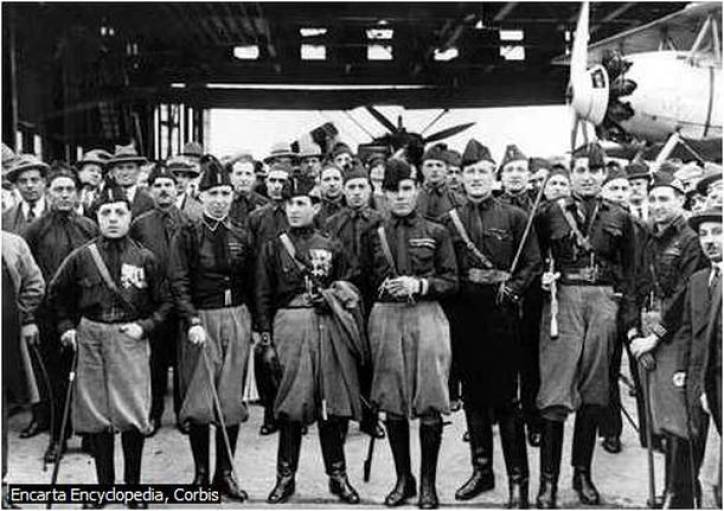
Following the March on Rome in October 1922 Mussolini became the youngest Prime Minister in Italian history. After removing all political opposition through his secret police and outlawing labor strikes, Mussolini and his followers consolidated their power through a series of laws that transformed the nation into a one-party dictatorship. Within five years he had established dictatorial authority by both legal and extraordinary means, aspiring to create a totalitarian state. Mussolini remained in power until he was deposed by King Victor Emmanuel III in 1943. With the fall of Mussolini from power in Rome, the King appointed Marshal Pietro Badoglio who led a transitional, military-led government in Italy from July 25, 1943, to April 24, 1944, following the fall of Mussolini. His government surrendered to the Allies on September 8, 1943, shifting Italy to a "cobelligerent" status, which triggered a German occupation of the north and the return of Mussolini with a German-captivated government, civil war, and the king's flight. Italians who had been fighting in the Italian army now were offered three alternatives: go north to fight with the Germans, stay and fight with the Allies, or go home. Most joined the Allied army. In Italy north of the Apennines, a fierce battle now raged between pro-Communist Partisans (I Partigiani) and the German army. Thousands of Italians died in this war with the German army, and it was this army of Partigiani who liberated many norther cities and thus were in charge until the army of the British and Americans reached the north. Allied forces reached Northern Italy and began liberating the region following their final spring offensive, which broke the German lines in April 1945. By April 24, 1945, the U.S. Fifth Army had reached the Po River, and a general uprising of Italian partisans occurred on 25 April 1945. The final offensive against the Gothic Line began on April 14, 1945. Following the collapse of the German defense, Allied forces crossed the Po River and secured key northern cities, including Bologna which was liberated on April 21, 1945. German forces in Italy officially surrendered on May 2, 1945.
RECOMMENDED READING
Mussolini's Italy: Life Under the Fascist Dictatorship, 1915-1945,
Penguin Press HC, The; 1st American Edition edition (February 2, 2006),
ISBN 1594200785