Week 11
Week 11: Tuesday, January 5, 2027
Colonizers: England, France, Spain
Week 11
Spain, France, and England had very different goals in the Americas in the age of 17th century colonies. Spain wanted gold and Catholic converts. France wanted fur and trade. The English who came over from England in the 17th century wanted land, permanent homes and space so that they could build a new community with freedom from the religious oppression of the homeland. The Spaniards on the other hand came looking for gold. They set up local tyrannies run by Spanish overlords and used forced local labor on huge ranches and mines. There was no democracy, no self-government. The French focused on the fur trade. They built deep trade networks instead of clearing huge forests.
REQUIRED READING FOR THE WHOLE YEAR OF COMING TO AMERICA

From the Publisher:
"For too long we’ve lacked a compact, inexpensive, authoritative, and compulsively readable book that offers American readers a clear, informative, and inspiring narrative account of their country. Such a fresh retelling of the American story is especially needed today, to shape and deepen young Americans’ sense of the land they inhabit, help them to understand its roots and share in its memories, all the while equipping them for the privileges and responsibilities of citizenship in American society. The existing texts simply fail to tell that story with energy and conviction. Too often they reflect a fragmented outlook that fails to convey to American readers the grand trajectory of their own history. A great nation needs and deserves a great and coherent narrative, as an expression of its own self-understanding and its aspirations; and it needs to be able to convey that narrative effectively. Of course, it goes without saying that such a narrative cannot be a fairy tale of the past. It will not be convincing if it is not truthful. But as Land of Hope brilliantly shows, there is no contradiction between a truthful account of the American past and an inspiring one. Readers of Land of Hope will find both in its pages."
REVIEWS
“At a time of severe partisanship that has infected many accounts of our nation’s past, this brilliant new history, Land of Hope, written in lucid and often lyrical prose, is much needed. It is accurate, honest, and free of the unhistorical condescension so often paid to the people of America’s past. This generous but not uncritical story of our nation’s history ought to be read by every American. It explains and justifies the right kind of patriotism.”― Gordon S. Wood, author of Friends Divided: John Adams and Thomas Jefferson
“We’ve long needed a readable text that truly tells the American story, neither hiding the serious injustices in our history nor soft-pedaling our nation’s extraordinary achievements. Such a text cannot be a mere compilation of facts, and it certainly could not be written by someone lacking a deep understanding and appreciation of America’s constitutional ideals and institutions. Bringing his impressive skills as a political theorist, historian, and writer to bear, Wilfred McClay has supplied the need.”― Robert P. George, McCormick Professor of Jurisprudence, Princeton University
“No one has told the story of America with greater balance or better prose than Wilfred McClay. Land of Hope is a history book that you will not be able to put down. From the moment that ‘natives’ first crossed here over the Bering Strait, to the founding of America’s great experiment in republican government, to the horror and triumph of the Civil War...McClay’s account will capture your attention while offering an unforgettable education.”― James W. Ceaser, Professor of Politics, University of Virginia
RECOMMENDED READING
Empires of the Atlantic World: Britain and Spain in America 1492-1830,
Yale University Press,
ISBN 978-0300253399
12
Week 12: Tuesday, January 12, 2027
Jamestown
Week 12
On May 14, 1607, a group of roughly 100 members of a joint venture called the Virginia Company founded the first permanent English settlement in North America on the banks of the James River. Famine, disease and conflict with local Native American tribes in the first two years brought Jamestown to the brink of failure before the arrival of a new group of settlers and supplies in 1610. Tobacco became Virginia’s first profitable export, and a period of peace followed the marriage of colonist John Rolfe to Pocahontas, the daughter of an Algonquian chief. During the 1620s, Jamestown expanded from the area around the original James Fort into a New Town built to the east. It remained the capital of the Virginia colony until 1699. In 1606, King James I granted a charter to a new venture, the Virginia Company, to form a settlement in North America. At the time, Virginia was the English name for the entire eastern coast of North America north of Florida; they had named it for Elizabeth I, the “virgin queen.” The Virginia Company planned to search for gold and silver deposits in the New World, as well as a river route to the Pacific Ocean that would allow them to establish trade with the Orient. Roughly 100 colonists left England in late December 1606 on three ships (the Susan Constant, the Godspeed and the Discovery) and reached Chesapeake Bay late the next April. After forming a governing council—including Christopher Newport, commander of the sea voyage, and Captain John Smith, a former mercenary who had been accused of insubordination aboard ship by several other company members—the group searched for a suitable settlement site. On May 13, 1607, they landed on a narrow peninsula—virtually an island—in the James River, where they would begin their lives in the New World. Known variously as James Forte, James Towne and James Cittie, the new settlement initially consisted of a wooden fort built in a triangle around a storehouse for weapons and other supplies, a church and a number of houses. By the summer of 1607, Newport went back to England with two ships and 40 crewmembers to give a report to the king and to gather more supplies and colonists. The settlers left behind suffered greatly from hunger and illnesses like typhoid and dysentery, caused from drinking contaminated water from the nearby swamp. Settlers also lived under constant threat of attack by members of local Algonquian tribes, most of which were organized into a kind of empire under Chief Powhatan. An understanding reached between Powhatan and John Smith led the settlers to establish much-needed trade with Powhatan’s tribe by early 1608. Though skirmishes still broke out between the two groups, the Native Americans traded corn for beads, metal tools and other objects (including some weapons) from the English, who would depend on this trade for sustenance in the colony’s early years. After Smith returned to England in late 1609, the inhabitants of Jamestown suffered through a long, harsh winter known as “The Starving Time,” during which more than 100 of them died. Firsthand accounts describe desperate people eating pets and shoe leather. In the spring of 1610, just as the remaining colonists were set to abandon Jamestown, two ships arrived bearing at least 150 new settlers, a cache of supplies and the new English governor of the colony, Lord De La Warr. Though De La Warr soon took ill and went home, his successor Sir Thomas Gates and Gates’ second-in command, Sir Thomas Dale, took firm charge of the colony and issued a system of new laws that, among other things, strictly controlled the interactions between settlers and Algonquians. The English began to build other forts and settlements up and down the James River, and by the fall of 1611 had managed to harvest a decent crop of corn themselves. They had also learned other valuable techniques from the Algonquians, including how to insulate their dwellings against the weather using tree bark, and expanded Jamestown into a New Town to the east of the original fort. A period of relative peace followed the marriage in April 1614 of the colonist and tobacco planter John Rolfe to Pocahontas, a daughter of Chief Powhatan who had been captured by the settlers and converted to Christianity. (According to John Smith, Pocahontas had rescued him from death in 1607, when she was just a young girl and he was her father’s captive.) Thanks largely to Rolfe’s introduction of a new type of tobacco grown from seeds from the West Indies, Jamestown’s economy began to thrive. In 1619, the colony established a General Assembly with members elected by Virginia’s male landowners; it would become a model for representative governments in later colonies. That same year, the first Africans (around 50 men, women and children) arrived in the English settlement; they had been on a Portuguese slave ship captured in the West Indies and brought to the Jamestown region. They worked as indentured servants at first (the race-based slavery system developed in North America in the 1680s) and were most likely put to work picking tobacco. (History.com)
REQUIRED READING FOR THE WHOLE YEAR OF COMING TO AMERICA
RECOMMENDED READING
13
Week 13: Tuesday, January 19, 2027
The Mayflower at Plymouth
Week 13
"In 1620, occurred the single most important formative event in early American history, which would ultimately have an important bearing on the crisis of the American Republic. This was the landing, at New Plymouth in what was to become Massachusetts, on December 11, 1620, of the first settlers from the Mayflower. The original Virginia settlers had been gentlemen—adventurers, landless men, indentured servants, united by a common desire to better themselves socially and financially in the New World. The best of them were men cast in the sturdy English empirical tradition of fair-mindedness and freedom, who sought to apply the common law justly, govern sensibly in the common interest, and legislate according to the general needs of the Commonwealth. They and their progeny were to constitute one principal element in American tradition, both public and private—a useful, moderate, and creative element, good for all seasons. The Mayflower men—and women—were quite different. They came to America not primarily for gain or even livelihood, though they accepted both from God with gratitude, but to create His kingdom on earth. They were the zealots, the idealists, the utopians, the saints, and the best of them, or perhaps one should say the most extreme of them, were fanatical, uncompromising, and overweening in their self-righteousness. They were also immensely energetic, persistent, and courageous. They and their progeny were to constitute the other principal element in the American tradition, creative too but ideological and cerebral, prickly and unbending, fiercely unyielding on occasions to the point of self-destruction. These two traditions, as we shall see, were to establish themselves firmly and then to battle it out, sometimes constructively, occasionally with immense creative power, but sometimes also to the peril of society and the state."
Paul Johnson, A History of the American People (p. 28). Harper Perennial,1997
REQUIRED READING FOR THE WHOLE YEAR OF COMING TO AMERICA
RECOMMENDED READING
The book link leads you to the hardcover edition new, but we recommend purchasing your choice of a used hardcover.
14
Week 14: Tuesday, January 26, 2027
Massachusetts Bay Colony
Week 14
The Massachusetts Bay Colony (1628–1691), more formally the Colony of Massachusetts Bay, was an English settlement on the east coast of North America around Massachusetts Bay, a territory inhabited by Algonquian Native American tribes. The colony was in a territory the colonists called New England, with initial settlements on two natural harbors and surrounding land about 15.4 miles (24.8 km) apart—the areas around Salem and Boston, north of the previously established Plymouth Colony. The territory nominally administered by the Massachusetts Bay Colony covered much of central New England, including portions of what are now Massachusetts, Maine, New Hampshire, and Connecticut. The territory of the Massachusetts Bay colony was one of the several colonial territories reorganized as the Province of Massachusetts Bay in 1691. The Massachusetts Bay Colony was founded by the owners of the Massachusetts Bay Company—a joint-stock company established by English royal charter. The company included investors in the failed Dorchester Company, which had established a short-lived settlement on Cape Ann in 1623; the Massachusetts Bay Colony was therefore a second attempt at colonization five years later. It was successful, with about 20,000 people migrating to New England in the 1630s. The population was Puritan and was governed largely by a small group of leaders strongly influenced by Puritan teachings. It was the first slave-holding colony in New England, and its governors were elected by an electorate limited to freemen who had been formally admitted to the local church. As a consequence, the colonial leadership showed little tolerance for other religious views, including Anglican, Quaker,[2] and Baptist theologies. The colonists had good relationships with the local Native Americans; however, they did join their neighbor colonies in the Pequot War (1636–1638) and King Philip's War (1675–1678). After that, most of the Indians in southern New England made peace treaties with the colonists. The Massachusetts Bay Colony was economically successful, trading with England, Mexico, and the West Indies. In addition to barter, transactions were done in English pounds, Spanish "pieces of eight", and wampum in the 1640s. In 1652, a currency shortage prompted the colony to authorize silversmith John Hull to issue coinage, now known as the oak tree, willow tree, and pine tree shillings. Political differences with England after the English Restoration led to the revocation of the colonial charter in 1684. King James II established the Dominion of New England in 1686 to bring all of the New England colonies under firmer crown control. The Dominion collapsed after the Glorious Revolution of 1688 deposed James, and the Massachusetts Bay Colony reverted to rule under its revoked charter until 1691, when a new charter was issued for the Province of Massachusetts Bay. This new province combined the Massachusetts Bay territories with those of the Plymouth Colony and proprietary holdings on Nantucket and Martha's Vineyard. Sir William Phips arrived in 1692 bearing the charter and formally took charge of the new province. (Wikipedia)
RECOMMENDED READING
The story of the Puritans begins back in the 16th century during the reign of Queen Elizabeth I. The Puritans slowly separated themselves off from the dominate monarchy-controlled English church and became more and more a kind of revolutionary movement within the Elizabethan court. All of Elizabeth's most trusted advisors were Puritans and she protected and advanced them. But when she died, and her cousin Mary's son James acceded to the throne, English Puritans began to leave England moving to the Netherlands and then to America in the early 1600s. David Hall's book gives us both the English story and the American one. It is highly recommended.
REQUIRED READING FOR THE WHOLE YEAR OF COMING TO AMERICA
15
Week 15: Tuesday, February 2, 2027
Roger William and Rhode Island
Week 15
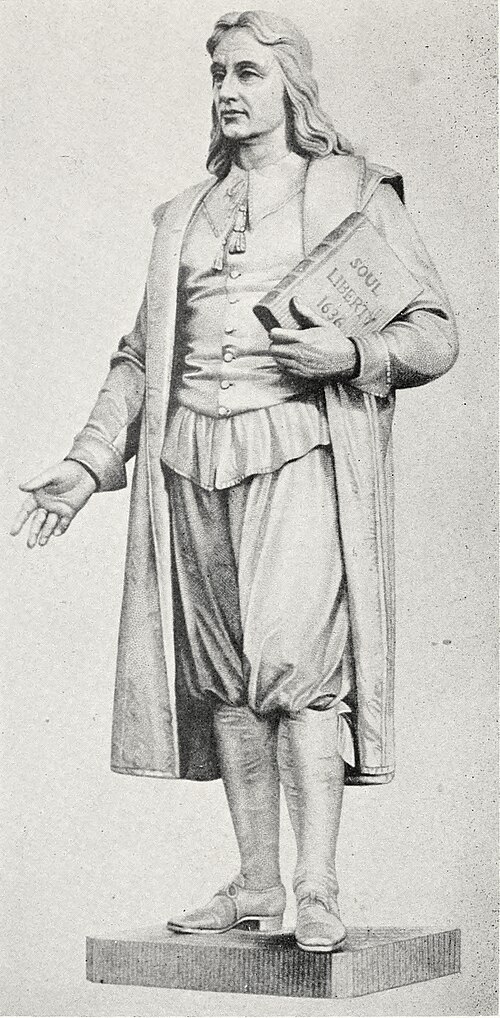
"Roger Williams (1603 – 1683) was an English-born New England minister, theologian, author, and founder of the Providence Plantations, which became the Colony of Rhode Island and Providence Plantations and later the State of Rhode Island. He was a staunch advocate for religious liberty, separation of church and state, and fair dealings with the Native Americans. Initially a Puritan minister, his beliefs evolved and he questioned the authority of the Puritan church in enforcing religious conformity. He was expelled by the Puritan leaders from the Massachusetts Bay Colony, and he established Providence Plantations in 1636 as a refuge offering what he termed "liberty of conscience" making Rhode Island the first government in the Western world to guarantee religious freedom in its founding charter. His ideas on religious tolerance and civil government directly influenced the principles later enshrined in the First Amendment of the U.S. Constitution. He briefly became a Baptist, and in 1638 he founded the First Baptist Church in America in Providence. He then moved beyond organized religion, becoming a "seeker" who did not identify with any specific church. Williams studied the language of the New England Native Americans and published the first book-length study of it in English. Today, Williams's legacy continues to shape debates on religious liberty and the role of government in matters of conscience, with his writings cited in legal arguments and Supreme Court decisions on the separation of church and state." (Wikipedia) Roger Williams is the key figure in our constitutional provision of separation of church and state. This idea was unacceptable to every government and every religious authority in the world when he proposed it. In 1787, when the Constitution was written in Philadelphia, it became the bedrock cornerstone of the American Constitution. The exact phrase "separation of church and state" does not appear in the U.S. Constitution. Instead, the legal concept is rooted in the Establishment Clause of the First Amendment, which states: "Congress shall make no law respecting an establishment of religion."
REQUIRED READING FOR THE WHOLE YEAR OF COMING TO AMERICA
RECOMMENDED READING
Roger Williams and the Creation of the American Soul: Church, State, and the Birth of Liberty,
Viking,
ISBN 978-0670023059
Hardcover format would be a good purchase choice for this book, not too expensive.
16
Week 16: Tuesday, February 9, 2027
The Dutch Buy Manhattan
Week 16
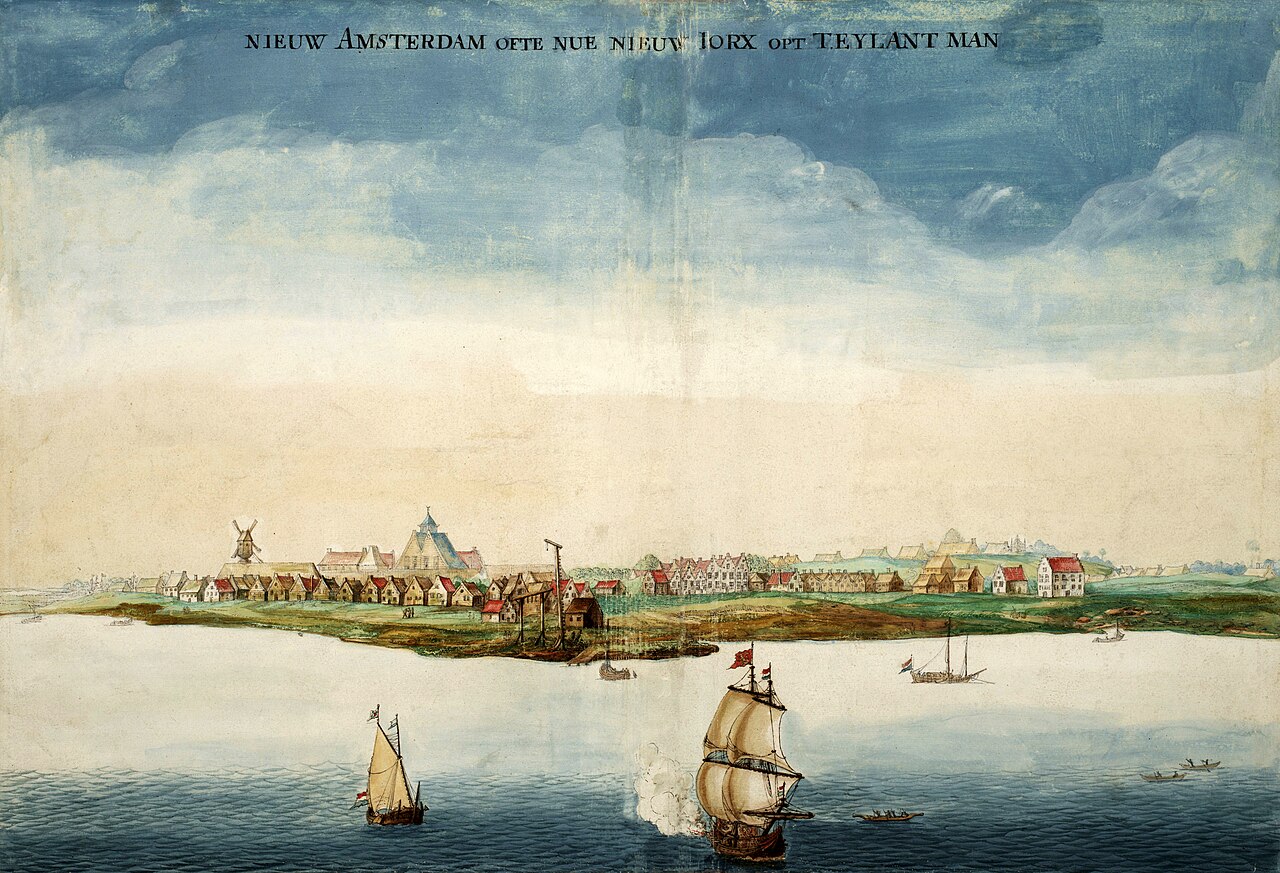
Before European colonization, present-day Manhattan was part of Lenape territory. European settlement began with the establishment of a trading post by Dutch colonists in 1624 on Manhattan Island; the post was named "New Amsterdam" in 1626. The territory came under English control in 1664 and was renamed "New York" after King Charles II of England granted the lands to his brother, the Duke of York. New York, based in present-day Lower Manhattan, served as the capital of the United States from 1785 until 1790. The Statue of Liberty in New York Harbor greeted millions of arriving immigrants in the late 19th century and is a world symbol of the United States and its ideals. Peter Minuit (French: Pierre Minuit, Dutch: Peter Minnewit (1580 – 1638) was a Flemish merchant and politician who arranged the purchase of Manhattan. He was the 3rd director of the Dutch North American colony of New Netherland from 1626 until 1631, and 3rd Governor of New Netherland. He later founded the Swedish colony of New Sweden on the Delaware Peninsula in 1638. Minuit was born in Wesel, in modern northwestern Germany. He is generally credited with orchestrating the purchase of Manhattan Island for the Dutch West India Company from representatives of the Lenape, the area's indigenous people. Manhattan later became the site of the Dutch city of New Amsterdam, and the borough of Manhattan of modern New York City. A letter written by Dutch merchant Peter Schaghen to directors of the Dutch East India Company stated that Manhattan was purchased for "60 guilders worth of trade", an amount worth ~$1,143 U.S. dollars as of 2020.
.....
REQUIRED READING FOR THE WHOLE YEAR OF COMING TO AMERICA
RECOMMENDED READING
The Island at the Center of the World: The Epic Story of Dutch Manhattan and the Forgotten Colony That Shaped America,
Vintage,
ISBN 978-1400078677
17
Week 17: Tuesday, February 16, 2027
William Penn and Pennsylvania
Week 17
William Penn (1644 – 1718) was an English writer, theologian, religious thinker, and influential Quaker who founded the Province of Pennsylvania. An advocate of democracy and religious freedom, Penn was known for his amicable relations and successful treaties with the Lenape native peoples who had resided in present-day Pennsylvania before European colonisation there. In 1681, King Charles II granted an area of land corresponding to the present-day U.S. states of Pennsylvania and Delaware to Penn to offset debts he owed Penn's father, the admiral and politician Sir William Penn. The following year, Penn left England and sailed up Delaware Bay and the Delaware River, where he founded Philadelphia on the river's western bank. Penn's Quaker government was not viewed favorably by the Dutch, Swedish and English settlers in what is now Delaware, and the land was also claimed by the Calverts, proprietors of the neighbouring Province of Maryland. In 1704, the three southernmost counties of the province of Pennsylvania were granted permission to form a new, semi-autonomous Delaware Colony. As one of the earliest supporters of colonial unification, Penn wrote and urged the union of all the British colonies into what would later become the United States. The democratic principles that he included in the West Jersey Concessions and outlined in the Pennsylvania Frame of Government inspired delegates to the 1787 Constitutional Convention in Philadelphia when they came to write the Constitution of the United States. A man of deep religious conviction, Penn authored numerous works, exhorting believers to adhere to the spirit of Primitive Christianity. Penn was imprisoned several times in the Tower of London due to his faith. His book No Cross, No Crown, published in 1669 while he was in jail, has become a classic of Christian theological literature.
REQUIRED READING FOR THE WHOLE YEAR OF COMING TO AMERICA
RECOMMENDED READING

Note: This William Penn book appears to be available only in hardcover and we know it is costly.
18
19
20
All
Week 11: Tue., Jan. 5, 2027
Colonizers: England, France, Spain
Week 11
Spain, France, and England had very different goals in the Americas in the age of 17th century colonies. Spain wanted gold and Catholic converts. France wanted fur and trade. The English who came over from England in the 17th century wanted land, permanent homes and space so that they could build a new community with freedom from the religious oppression of the homeland. The Spaniards on the other hand came looking for gold. They set up local tyrannies run by Spanish overlords and used forced local labor on huge ranches and mines. There was no democracy, no self-government. The French focused on the fur trade. They built deep trade networks instead of clearing huge forests.
REQUIRED READING FOR THE WHOLE YEAR OF COMING TO AMERICA
From the Publisher:
"For too long we’ve lacked a compact, inexpensive, authoritative, and compulsively readable book that offers American readers a clear, informative, and inspiring narrative account of their country. Such a fresh retelling of the American story is especially needed today, to shape and deepen young Americans’ sense of the land they inhabit, help them to understand its roots and share in its memories, all the while equipping them for the privileges and responsibilities of citizenship in American society. The existing texts simply fail to tell that story with energy and conviction. Too often they reflect a fragmented outlook that fails to convey to American readers the grand trajectory of their own history. A great nation needs and deserves a great and coherent narrative, as an expression of its own self-understanding and its aspirations; and it needs to be able to convey that narrative effectively. Of course, it goes without saying that such a narrative cannot be a fairy tale of the past. It will not be convincing if it is not truthful. But as Land of Hope brilliantly shows, there is no contradiction between a truthful account of the American past and an inspiring one. Readers of Land of Hope will find both in its pages."
REVIEWS
“At a time of severe partisanship that has infected many accounts of our nation’s past, this brilliant new history, Land of Hope, written in lucid and often lyrical prose, is much needed. It is accurate, honest, and free of the unhistorical condescension so often paid to the people of America’s past. This generous but not uncritical story of our nation’s history ought to be read by every American. It explains and justifies the right kind of patriotism.”― Gordon S. Wood, author of Friends Divided: John Adams and Thomas Jefferson
“We’ve long needed a readable text that truly tells the American story, neither hiding the serious injustices in our history nor soft-pedaling our nation’s extraordinary achievements. Such a text cannot be a mere compilation of facts, and it certainly could not be written by someone lacking a deep understanding and appreciation of America’s constitutional ideals and institutions. Bringing his impressive skills as a political theorist, historian, and writer to bear, Wilfred McClay has supplied the need.”― Robert P. George, McCormick Professor of Jurisprudence, Princeton University
“No one has told the story of America with greater balance or better prose than Wilfred McClay. Land of Hope is a history book that you will not be able to put down. From the moment that ‘natives’ first crossed here over the Bering Strait, to the founding of America’s great experiment in republican government, to the horror and triumph of the Civil War...McClay’s account will capture your attention while offering an unforgettable education.”― James W. Ceaser, Professor of Politics, University of Virginia
RECOMMENDED READING
Empires of the Atlantic World: Britain and Spain in America 1492-1830,
Yale University Press,
ISBN 978-0300253399
Week 12: Tue., Jan. 12, 2027
Jamestown
Week 12
On May 14, 1607, a group of roughly 100 members of a joint venture called the Virginia Company founded the first permanent English settlement in North America on the banks of the James River. Famine, disease and conflict with local Native American tribes in the first two years brought Jamestown to the brink of failure before the arrival of a new group of settlers and supplies in 1610. Tobacco became Virginia’s first profitable export, and a period of peace followed the marriage of colonist John Rolfe to Pocahontas, the daughter of an Algonquian chief. During the 1620s, Jamestown expanded from the area around the original James Fort into a New Town built to the east. It remained the capital of the Virginia colony until 1699. In 1606, King James I granted a charter to a new venture, the Virginia Company, to form a settlement in North America. At the time, Virginia was the English name for the entire eastern coast of North America north of Florida; they had named it for Elizabeth I, the “virgin queen.” The Virginia Company planned to search for gold and silver deposits in the New World, as well as a river route to the Pacific Ocean that would allow them to establish trade with the Orient. Roughly 100 colonists left England in late December 1606 on three ships (the Susan Constant, the Godspeed and the Discovery) and reached Chesapeake Bay late the next April. After forming a governing council—including Christopher Newport, commander of the sea voyage, and Captain John Smith, a former mercenary who had been accused of insubordination aboard ship by several other company members—the group searched for a suitable settlement site. On May 13, 1607, they landed on a narrow peninsula—virtually an island—in the James River, where they would begin their lives in the New World. Known variously as James Forte, James Towne and James Cittie, the new settlement initially consisted of a wooden fort built in a triangle around a storehouse for weapons and other supplies, a church and a number of houses. By the summer of 1607, Newport went back to England with two ships and 40 crewmembers to give a report to the king and to gather more supplies and colonists. The settlers left behind suffered greatly from hunger and illnesses like typhoid and dysentery, caused from drinking contaminated water from the nearby swamp. Settlers also lived under constant threat of attack by members of local Algonquian tribes, most of which were organized into a kind of empire under Chief Powhatan. An understanding reached between Powhatan and John Smith led the settlers to establish much-needed trade with Powhatan’s tribe by early 1608. Though skirmishes still broke out between the two groups, the Native Americans traded corn for beads, metal tools and other objects (including some weapons) from the English, who would depend on this trade for sustenance in the colony’s early years. After Smith returned to England in late 1609, the inhabitants of Jamestown suffered through a long, harsh winter known as “The Starving Time,” during which more than 100 of them died. Firsthand accounts describe desperate people eating pets and shoe leather. In the spring of 1610, just as the remaining colonists were set to abandon Jamestown, two ships arrived bearing at least 150 new settlers, a cache of supplies and the new English governor of the colony, Lord De La Warr. Though De La Warr soon took ill and went home, his successor Sir Thomas Gates and Gates’ second-in command, Sir Thomas Dale, took firm charge of the colony and issued a system of new laws that, among other things, strictly controlled the interactions between settlers and Algonquians. The English began to build other forts and settlements up and down the James River, and by the fall of 1611 had managed to harvest a decent crop of corn themselves. They had also learned other valuable techniques from the Algonquians, including how to insulate their dwellings against the weather using tree bark, and expanded Jamestown into a New Town to the east of the original fort. A period of relative peace followed the marriage in April 1614 of the colonist and tobacco planter John Rolfe to Pocahontas, a daughter of Chief Powhatan who had been captured by the settlers and converted to Christianity. (According to John Smith, Pocahontas had rescued him from death in 1607, when she was just a young girl and he was her father’s captive.) Thanks largely to Rolfe’s introduction of a new type of tobacco grown from seeds from the West Indies, Jamestown’s economy began to thrive. In 1619, the colony established a General Assembly with members elected by Virginia’s male landowners; it would become a model for representative governments in later colonies. That same year, the first Africans (around 50 men, women and children) arrived in the English settlement; they had been on a Portuguese slave ship captured in the West Indies and brought to the Jamestown region. They worked as indentured servants at first (the race-based slavery system developed in North America in the 1680s) and were most likely put to work picking tobacco. (History.com)
REQUIRED READING FOR THE WHOLE YEAR OF COMING TO AMERICA
RECOMMENDED READING
Week 13: Tue., Jan. 19, 2027
The Mayflower at Plymouth
Week 13
"In 1620, occurred the single most important formative event in early American history, which would ultimately have an important bearing on the crisis of the American Republic. This was the landing, at New Plymouth in what was to become Massachusetts, on December 11, 1620, of the first settlers from the Mayflower. The original Virginia settlers had been gentlemen—adventurers, landless men, indentured servants, united by a common desire to better themselves socially and financially in the New World. The best of them were men cast in the sturdy English empirical tradition of fair-mindedness and freedom, who sought to apply the common law justly, govern sensibly in the common interest, and legislate according to the general needs of the Commonwealth. They and their progeny were to constitute one principal element in American tradition, both public and private—a useful, moderate, and creative element, good for all seasons. The Mayflower men—and women—were quite different. They came to America not primarily for gain or even livelihood, though they accepted both from God with gratitude, but to create His kingdom on earth. They were the zealots, the idealists, the utopians, the saints, and the best of them, or perhaps one should say the most extreme of them, were fanatical, uncompromising, and overweening in their self-righteousness. They were also immensely energetic, persistent, and courageous. They and their progeny were to constitute the other principal element in the American tradition, creative too but ideological and cerebral, prickly and unbending, fiercely unyielding on occasions to the point of self-destruction. These two traditions, as we shall see, were to establish themselves firmly and then to battle it out, sometimes constructively, occasionally with immense creative power, but sometimes also to the peril of society and the state."
Paul Johnson, A History of the American People (p. 28). Harper Perennial,1997
REQUIRED READING FOR THE WHOLE YEAR OF COMING TO AMERICA
RECOMMENDED READING
The book link leads you to the hardcover edition new, but we recommend purchasing your choice of a used hardcover.
Week 14: Tue., Jan. 26, 2027
Massachusetts Bay Colony
Week 14
The Massachusetts Bay Colony (1628–1691), more formally the Colony of Massachusetts Bay, was an English settlement on the east coast of North America around Massachusetts Bay, a territory inhabited by Algonquian Native American tribes. The colony was in a territory the colonists called New England, with initial settlements on two natural harbors and surrounding land about 15.4 miles (24.8 km) apart—the areas around Salem and Boston, north of the previously established Plymouth Colony. The territory nominally administered by the Massachusetts Bay Colony covered much of central New England, including portions of what are now Massachusetts, Maine, New Hampshire, and Connecticut. The territory of the Massachusetts Bay colony was one of the several colonial territories reorganized as the Province of Massachusetts Bay in 1691. The Massachusetts Bay Colony was founded by the owners of the Massachusetts Bay Company—a joint-stock company established by English royal charter. The company included investors in the failed Dorchester Company, which had established a short-lived settlement on Cape Ann in 1623; the Massachusetts Bay Colony was therefore a second attempt at colonization five years later. It was successful, with about 20,000 people migrating to New England in the 1630s. The population was Puritan and was governed largely by a small group of leaders strongly influenced by Puritan teachings. It was the first slave-holding colony in New England, and its governors were elected by an electorate limited to freemen who had been formally admitted to the local church. As a consequence, the colonial leadership showed little tolerance for other religious views, including Anglican, Quaker,[2] and Baptist theologies. The colonists had good relationships with the local Native Americans; however, they did join their neighbor colonies in the Pequot War (1636–1638) and King Philip's War (1675–1678). After that, most of the Indians in southern New England made peace treaties with the colonists. The Massachusetts Bay Colony was economically successful, trading with England, Mexico, and the West Indies. In addition to barter, transactions were done in English pounds, Spanish "pieces of eight", and wampum in the 1640s. In 1652, a currency shortage prompted the colony to authorize silversmith John Hull to issue coinage, now known as the oak tree, willow tree, and pine tree shillings. Political differences with England after the English Restoration led to the revocation of the colonial charter in 1684. King James II established the Dominion of New England in 1686 to bring all of the New England colonies under firmer crown control. The Dominion collapsed after the Glorious Revolution of 1688 deposed James, and the Massachusetts Bay Colony reverted to rule under its revoked charter until 1691, when a new charter was issued for the Province of Massachusetts Bay. This new province combined the Massachusetts Bay territories with those of the Plymouth Colony and proprietary holdings on Nantucket and Martha's Vineyard. Sir William Phips arrived in 1692 bearing the charter and formally took charge of the new province. (Wikipedia)
RECOMMENDED READING
The story of the Puritans begins back in the 16th century during the reign of Queen Elizabeth I. The Puritans slowly separated themselves off from the dominate monarchy-controlled English church and became more and more a kind of revolutionary movement within the Elizabethan court. All of Elizabeth's most trusted advisors were Puritans and she protected and advanced them. But when she died, and her cousin Mary's son James acceded to the throne, English Puritans began to leave England moving to the Netherlands and then to America in the early 1600s. David Hall's book gives us both the English story and the American one. It is highly recommended.
REQUIRED READING FOR THE WHOLE YEAR OF COMING TO AMERICA
Week 15: Tue., Feb. 2, 2027
Roger William and Rhode Island
Week 15
"Roger Williams (1603 – 1683) was an English-born New England minister, theologian, author, and founder of the Providence Plantations, which became the Colony of Rhode Island and Providence Plantations and later the State of Rhode Island. He was a staunch advocate for religious liberty, separation of church and state, and fair dealings with the Native Americans. Initially a Puritan minister, his beliefs evolved and he questioned the authority of the Puritan church in enforcing religious conformity. He was expelled by the Puritan leaders from the Massachusetts Bay Colony, and he established Providence Plantations in 1636 as a refuge offering what he termed "liberty of conscience" making Rhode Island the first government in the Western world to guarantee religious freedom in its founding charter. His ideas on religious tolerance and civil government directly influenced the principles later enshrined in the First Amendment of the U.S. Constitution. He briefly became a Baptist, and in 1638 he founded the First Baptist Church in America in Providence. He then moved beyond organized religion, becoming a "seeker" who did not identify with any specific church. Williams studied the language of the New England Native Americans and published the first book-length study of it in English. Today, Williams's legacy continues to shape debates on religious liberty and the role of government in matters of conscience, with his writings cited in legal arguments and Supreme Court decisions on the separation of church and state." (Wikipedia) Roger Williams is the key figure in our constitutional provision of separation of church and state. This idea was unacceptable to every government and every religious authority in the world when he proposed it. In 1787, when the Constitution was written in Philadelphia, it became the bedrock cornerstone of the American Constitution. The exact phrase "separation of church and state" does not appear in the U.S. Constitution. Instead, the legal concept is rooted in the Establishment Clause of the First Amendment, which states: "Congress shall make no law respecting an establishment of religion."
REQUIRED READING FOR THE WHOLE YEAR OF COMING TO AMERICA
RECOMMENDED READING
Roger Williams and the Creation of the American Soul: Church, State, and the Birth of Liberty,
Viking,
ISBN 978-0670023059
Hardcover format would be a good purchase choice for this book, not too expensive.
Week 16: Tue., Feb. 9, 2027
The Dutch Buy Manhattan
Week 16
Before European colonization, present-day Manhattan was part of Lenape territory. European settlement began with the establishment of a trading post by Dutch colonists in 1624 on Manhattan Island; the post was named "New Amsterdam" in 1626. The territory came under English control in 1664 and was renamed "New York" after King Charles II of England granted the lands to his brother, the Duke of York. New York, based in present-day Lower Manhattan, served as the capital of the United States from 1785 until 1790. The Statue of Liberty in New York Harbor greeted millions of arriving immigrants in the late 19th century and is a world symbol of the United States and its ideals. Peter Minuit (French: Pierre Minuit, Dutch: Peter Minnewit (1580 – 1638) was a Flemish merchant and politician who arranged the purchase of Manhattan. He was the 3rd director of the Dutch North American colony of New Netherland from 1626 until 1631, and 3rd Governor of New Netherland. He later founded the Swedish colony of New Sweden on the Delaware Peninsula in 1638. Minuit was born in Wesel, in modern northwestern Germany. He is generally credited with orchestrating the purchase of Manhattan Island for the Dutch West India Company from representatives of the Lenape, the area's indigenous people. Manhattan later became the site of the Dutch city of New Amsterdam, and the borough of Manhattan of modern New York City. A letter written by Dutch merchant Peter Schaghen to directors of the Dutch East India Company stated that Manhattan was purchased for "60 guilders worth of trade", an amount worth ~$1,143 U.S. dollars as of 2020.
.....
REQUIRED READING FOR THE WHOLE YEAR OF COMING TO AMERICA
RECOMMENDED READING
The Island at the Center of the World: The Epic Story of Dutch Manhattan and the Forgotten Colony That Shaped America,
Vintage,
ISBN 978-1400078677
Week 17: Tue., Feb. 16, 2027
William Penn and Pennsylvania
Week 17
William Penn (1644 – 1718) was an English writer, theologian, religious thinker, and influential Quaker who founded the Province of Pennsylvania. An advocate of democracy and religious freedom, Penn was known for his amicable relations and successful treaties with the Lenape native peoples who had resided in present-day Pennsylvania before European colonisation there. In 1681, King Charles II granted an area of land corresponding to the present-day U.S. states of Pennsylvania and Delaware to Penn to offset debts he owed Penn's father, the admiral and politician Sir William Penn. The following year, Penn left England and sailed up Delaware Bay and the Delaware River, where he founded Philadelphia on the river's western bank. Penn's Quaker government was not viewed favorably by the Dutch, Swedish and English settlers in what is now Delaware, and the land was also claimed by the Calverts, proprietors of the neighbouring Province of Maryland. In 1704, the three southernmost counties of the province of Pennsylvania were granted permission to form a new, semi-autonomous Delaware Colony. As one of the earliest supporters of colonial unification, Penn wrote and urged the union of all the British colonies into what would later become the United States. The democratic principles that he included in the West Jersey Concessions and outlined in the Pennsylvania Frame of Government inspired delegates to the 1787 Constitutional Convention in Philadelphia when they came to write the Constitution of the United States. A man of deep religious conviction, Penn authored numerous works, exhorting believers to adhere to the spirit of Primitive Christianity. Penn was imprisoned several times in the Tower of London due to his faith. His book No Cross, No Crown, published in 1669 while he was in jail, has become a classic of Christian theological literature.
REQUIRED READING FOR THE WHOLE YEAR OF COMING TO AMERICA
RECOMMENDED READING
Note: This William Penn book appears to be available only in hardcover and we know it is costly.