Week 1
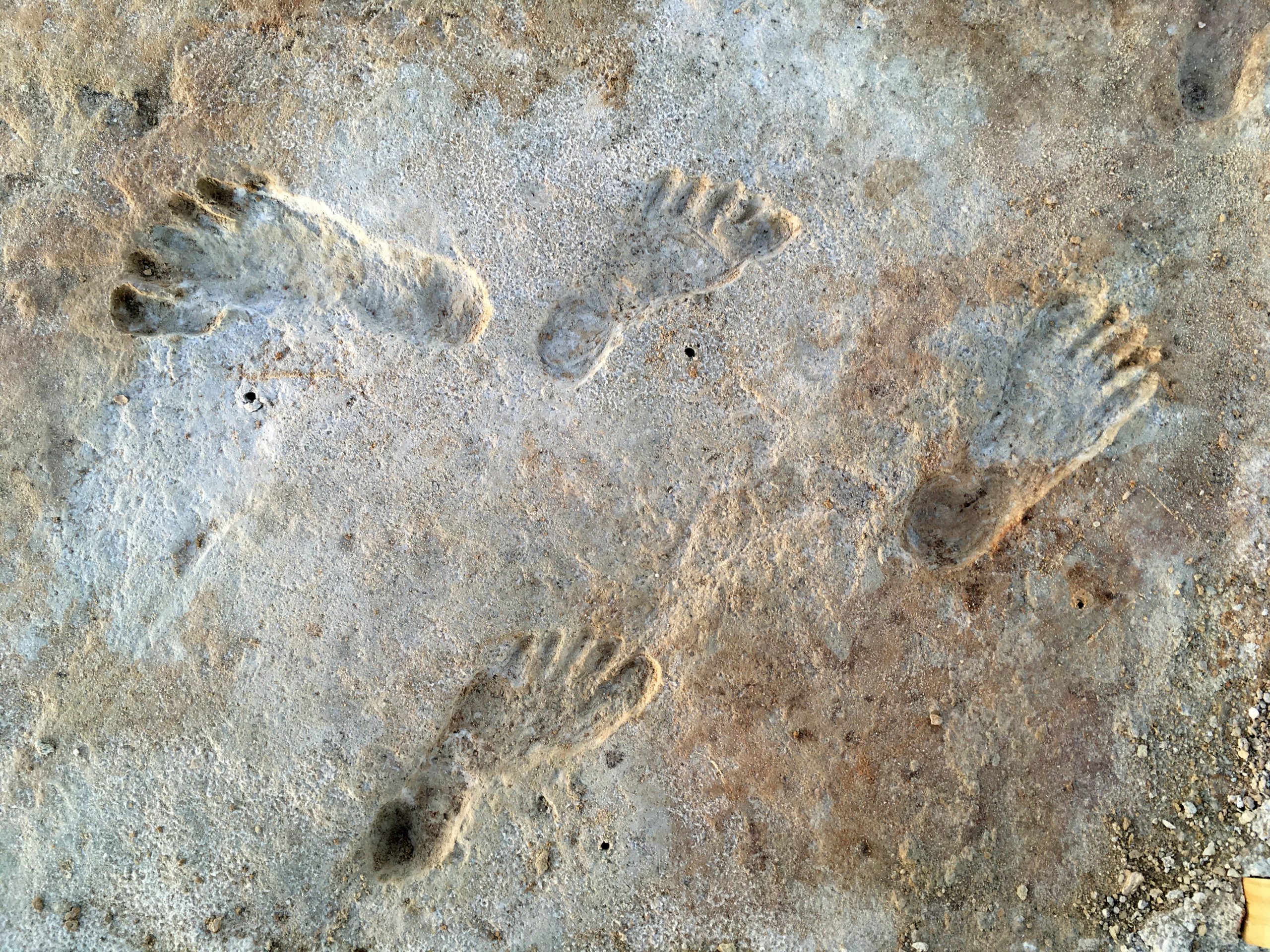
Who was here in the Americas when the first European explorers arrived? Millions of people had lived on both North and South American continents when Columbus arrived in the Caribbean in October of 1492. The latest archaeological evidence just recently discovered in New Mexico suggests that there were human beings here as early as 18,000 BC. White Sands National Park in New Mexico sits within the Tularosa Basin, a closed desert basin with no natural drainage outlet, bounded by the San Andres Mountains to the west and the Sacramento Mountains to the east. The basin once held Paleolake Otero, a shallow lake that filled it during the last Ice Age; because the basin has no outlet, the lake's gypsum-rich sediments were never carried away. Within this gypsum sediment are the footprints: human tracks pressed into mud at the ancient lake's edge, then buried and preserved as the basin dried around them. These footprints are the oldest securely dated evidence of human presence in the Americas. Radiocarbon dating of layers bracketing the tracks places them at roughly ~23,000—21,000 years ago, roughly 2,000 years of repeated human activity when people repeatedly walked along the wet margins of ancient Lake Otero. Here below is a photo of the footprints of one of those first human beings in America.
...............
REQUIRED READING FOR THE WHOLE YEAR OF COMING TO AMERICA

From the Publisher:
"For too long we’ve lacked a compact, inexpensive, authoritative, and compulsively readable book that offers American readers a clear, informative, and inspiring narrative account of their country. Such a fresh retelling of the American story is especially needed today, to shape and deepen young Americans’ sense of the land they inhabit, help them to understand its roots and share in its memories, all the while equipping them for the privileges and responsibilities of citizenship in American society. The existing texts simply fail to tell that story with energy and conviction. Too often they reflect a fragmented outlook that fails to convey to American readers the grand trajectory of their own history. A great nation needs and deserves a great and coherent narrative, as an expression of its own self-understanding and its aspirations; and it needs to be able to convey that narrative effectively. Of course, it goes without saying that such a narrative cannot be a fairy tale of the past. It will not be convincing if it is not truthful. But as Land of Hope brilliantly shows, there is no contradiction between a truthful account of the American past and an inspiring one. Readers of Land of Hope will find both in its pages."
REVIEWS
“At a time of severe partisanship that has infected many accounts of our nation’s past, this brilliant new history, Land of Hope, written in lucid and often lyrical prose, is much needed. It is accurate, honest, and free of the unhistorical condescension so often paid to the people of America’s past. This generous but not uncritical story of our nation’s history ought to be read by every American. It explains and justifies the right kind of patriotism.”― Gordon S. Wood, author of Friends Divided: John Adams and Thomas Jefferson
“We’ve long needed a readable text that truly tells the American story, neither hiding the serious injustices in our history nor soft-pedaling our nation’s extraordinary achievements. Such a text cannot be a mere compilation of facts, and it certainly could not be written by someone lacking a deep understanding and appreciation of America’s constitutional ideals and institutions. Bringing his impressive skills as a political theorist, historian, and writer to bear, Wilfred McClay has supplied the need.”― Robert P. George, McCormick Professor of Jurisprudence, Princeton University
“No one has told the story of America with greater balance or better prose than Wilfred McClay. Land of Hope is a history book that you will not be able to put down. From the moment that ‘natives’ first crossed here over the Bering Strait, to the founding of America’s great experiment in republican government, to the horror and triumph of the Civil War...McClay’s account will capture your attention while offering an unforgettable education.”― James W. Ceaser, Professor of Politics, University of Virginia