Week 6
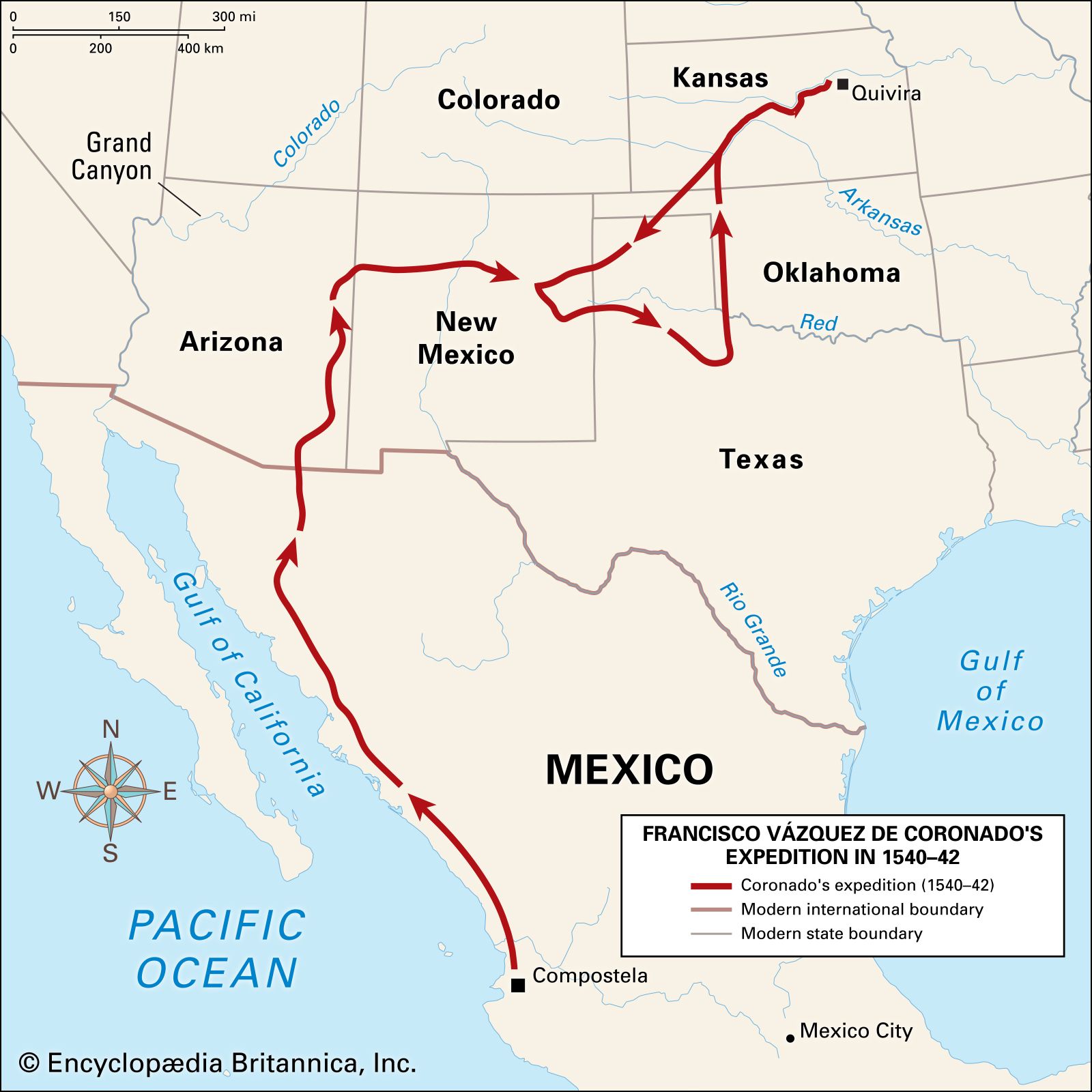
Long before Englishmen landed on the shores of Virginia and the rocks of Plymouth, Spanish explorers had already traversed the Atlantic coast from Labrador to the Strait of Magellan, and determined the extent of North America from Florida to California. Between 1539 and 1543, three Spanish expeditions explored the interior and western coast of the present United States. One expedition led by Hernando de Soto travelled from Florida to the Mississippi River and beyond. Francisco Vázquez de Coronado led an expedition from the west Mexican coast to central Kansas. The third expedition was led by Juan Rodriguez Cabrillo and explored the country from the west Mexican coast to possibly the Rogue River in Oregon. Collectively, these Spanish explorers determined the size of North America and assessed its abundant natural resources. Within this vast land lived many American Indian cultural groups, which the Spanish described in print for the first time within the Eurocentric context of the period. Francisco Vázquez de Coronado (1510–1554) was a Spanish conquistador and explorer who led a large expedition from what is now Mexico to present-day Kansas through what is now parts of the southwestern United States between 1540 and 1542. Vázquez de Coronado had hoped to reach the Cities of Cíbola, often referred to now as the mythical Seven Cities of Gold. His expedition marked the first European sightings of the Grand Canyon and the Colorado River, among other landmarks. Vázquez de Coronado was born into a noble family in Salamanca, Spain, in 1510 as the second son of Juan Vázquez de Coronado and Isabel de Luján. Juan Vázquez held various positions in the administration of the recently captured Emirate of Granada under Íñigo López de Mendoza, its first Christian governor. Francisco Vázquez de Coronado went to New Spain (present-day Mexico) in 1535 at about age 25, in the entourage of its first Viceroy, Antonio de Mendoza, the son of his father's patron and Vázquez de Coronado's personal friend. In New Spain, he married twelve-year-old Beatriz de Estrada, called "the Saint" (la Santa), sister of Leonor de Estrada, ancestor of the de Alvarado family and daughter of Treasurer and Governor Alonso de Estrada y Hidalgo, Lord of Picón, and his wife Marina Flores Gutiérrez de la Caballería, from a converso Jewish family. Vázquez de Coronado inherited a large portion of a Mexican encomendero estate through Beatriz and had eight children with her.